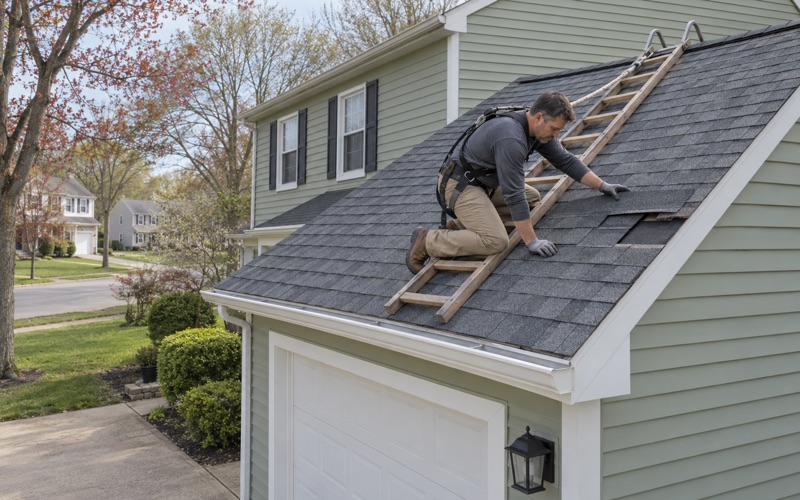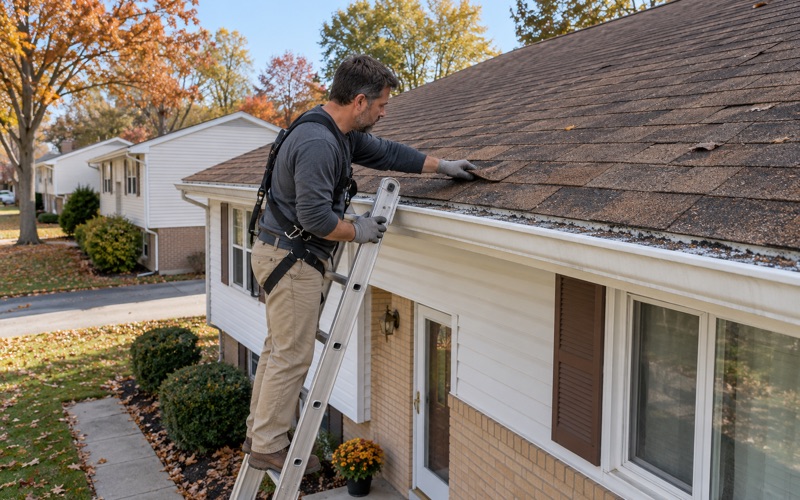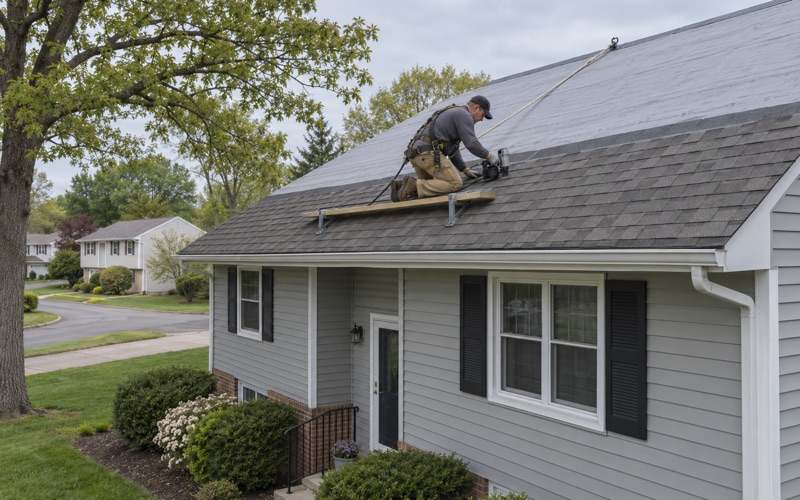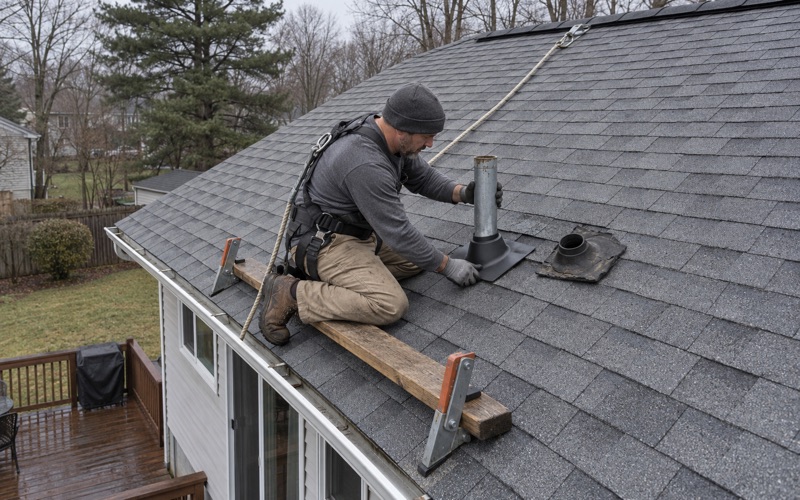
East Brunswick has handled roofing in Asbury Park and across central New Jersey for more than 20 years, and most of that work is on houses, two-family homes and small apartment buildings. We start every leak call in the attic as well as on the roof, so the price we give is for the place water actually gets in rather than for the stain on the ceiling below it.
Before replacement comes up at all, we tell an owner plainly whether the roof can be repaired. When it cannot, the written scope breaks out tear-off, decking, underlayment, flashing, ventilation and gutters as separate lines. That lets a homeowner set our estimate beside anyone else’s and compare the same items, rather than two totals that may hide very different work.
This page also looks at a much larger roof job underway in town right now, because it shows how far a building’s size and funding change the work. An owner who understands how a landmark roof is planned and paid for is better placed to ask sharp questions about the far smaller one over their own head.
Convention Hall and the Paramount, Closed Since 2021
A complex built for the boardwalk
Convention Hall, the Grand Arcade and the Paramount Theater make up one complex on the Asbury Park boardwalk. It was designed by the New York firm Warren & Wetmore and built in the late 1920s and early 1930s, and Convention Hall officially opened in 1930. Convention Hall seats 3,600 people and the Paramount 1,600, which gives a sense of the scale under those roofs.
The city reports that the Paramount and Convention Hall have been closed since about 2021 because of structural safety concerns. For buildings that size, a closure of that length is not a matter of patching a few leaks. It points to a structure where the roof, the walls and the steel that carries them all have to be dealt with together.
Roof reconstruction comes first
The Coaster reported in March 2026 that the Paramount’s work package is roof reconstruction, masonry renewal and structural steel repairs, so that the building is watertight and sound. Putting the roof at the front of that list is the normal order on any restoration. Interior plaster, finishes and systems cannot be restored safely while water still finds a way in from above.
A preservation consultant’s project page lists replacement of the Paramount roof among the theater’s work, alongside a historic tax credit application. What the new roof will be made of, what that portion costs, who is now building it and when it will be done have not been published in anything we have read, so we do not guess at any of those.
Watertight before anything else
Making an old building watertight means the roof, the masonry it meets and the flashing between them all shed water as one system. On a landmark, the steel under the deck has to be sound before a new roof can be fastened to it. Restoration work is sequenced that way because a new roof laid over failing structure only hides the problem for a while.
Looking for roofing closer to East Hanover? See Roofing in East Hanover.
The Boardwalk Preservation Grant and Its Deadline
What the state money depends on
The exterior work on the Paramount must be completed by the end of 2026 to secure $11.7 million in state funding from the Boardwalk Preservation Grant, according to The Coaster. That date is set by the funding, not by the weather or the building. Missing it puts the money at risk, which is why the exterior, roof included, sits on a tight calendar.
The city has approved Resolution 2026-183, an addendum to the Boardwalk Preservation Fund sub-grant agreement for the Paramount Theater Phase II project. In March, The Coaster also reported that a Phase 2 subgrant agreement had not yet been signed. Public money tends to move in stages like this, and each stage carries its own paperwork and conditions.
A contractor withdrew in March
The first contractor on the theater repairs, March Associates Construction, withdrew in March 2026, The Coaster reported. On a job with a fixed public deadline, losing a contractor partway through compresses everything that follows. Bidding, award and mobilization all have to happen again while the calendar keeps running toward the end of the year.
Tax credits for the whole complex
On August 20, 2026, the NJEDA Board approved a tax credit of up to $75 million from its Cultural Arts Facilities Expansion program, known as CAFE, toward the $130 million restoration of the Convention Hall complex. The city describes the work as structural, mechanical and architectural upgrades plus ADA accessibility. Construction began in April at the applicant’s own risk, before that approval came through.
Those figures are easy to misread. The $75 million is a tax credit of up to that amount toward the whole $130 million project, not cash set aside for one roof, and the $11.7 million depends on the exterior deadline being met. Neither number is a roof budget, and no one has published what the Paramount roof itself costs.
How a Grant-Funded Landmark Roof Is Phased
Phases follow the money
Restoration money for public buildings usually arrives in phases, and the work is arranged to match. The Paramount’s current agreements are labeled Phase II, and the exterior package carries its own completion date tied to its own grant. A roof on a project like this is scheduled around what each funding stage requires to be finished and documented, not around the most convenient season.
Structure, masonry and roof together
Because the package pairs roof reconstruction with masonry renewal and structural steel repairs, the trades overlap. Steel has to be repaired before the deck goes down, and walls and parapets have to be renewed where the new roof ties into them. Flashing at those joints is where an old masonry building commonly lets water in, so it is built with the roof rather than after it.
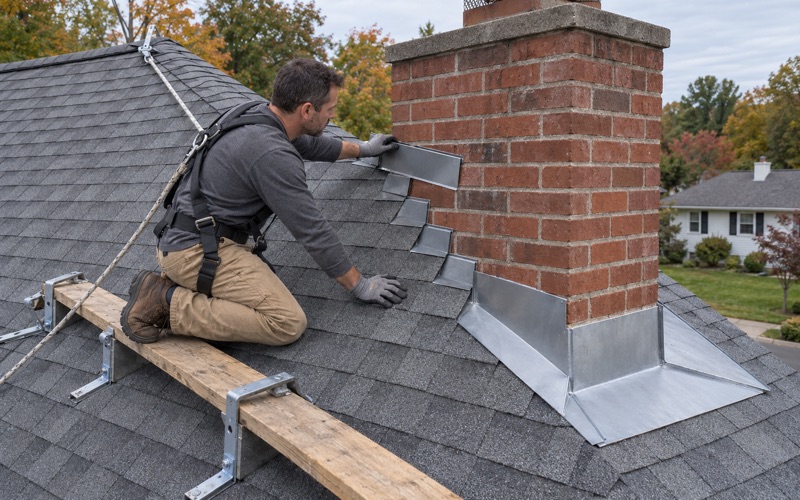
The same principle governs our work on houses, at a much smaller scale. We replace step, counter and chimney flashing with every new roof instead of reusing old metal under new material. A fresh roof laid against tired flashing tends to fail at the joint first, and the joint at a brick chimney is a very common place for a leak to start.
Commercial roof systems
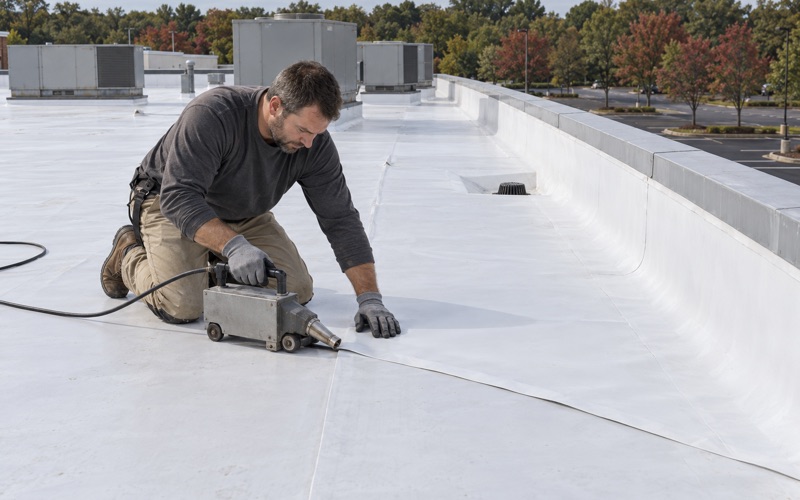
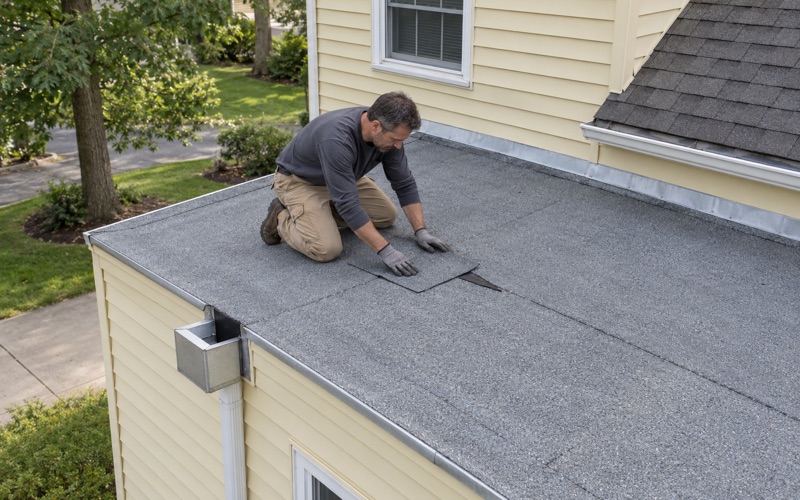
Large commercial and institutional roofs are commonly built from systems such as torch-down SBS or APP modified bitumen, EPDM rubber, or TPO and PVC single-ply membranes, and some carry standing seam metal. Which of these, if any, the Paramount will use has not been published. On any big building the choice depends on the deck, the slope and the detailing at every wall and opening.
Commercial Landmark Roofs Versus a House Re-Roof in Asbury Park
What applies to most homes here
Most roofs in Asbury Park sit on far smaller buildings under far simpler rules. Replacing the roof covering on a detached one- or two-family house is ordinary maintenance under the New Jersey construction code, so it needs no construction permit, inspection or notice. Work that affects structural or fire safety falls outside that exemption, and so do attached rows and buildings of three or more units.
Every estimate we write states plainly whether the job is permit work under the state construction code. Where it is, the application goes to the Asbury Park Construction Department at 1 Municipal Plaza, second floor north, and inspections can be requested online through the city’s SDL portal. Buildings of two to four units hold 1,759 of the city’s housing units, so that line on the estimate matters here.
Old buildings and careful tear-offs
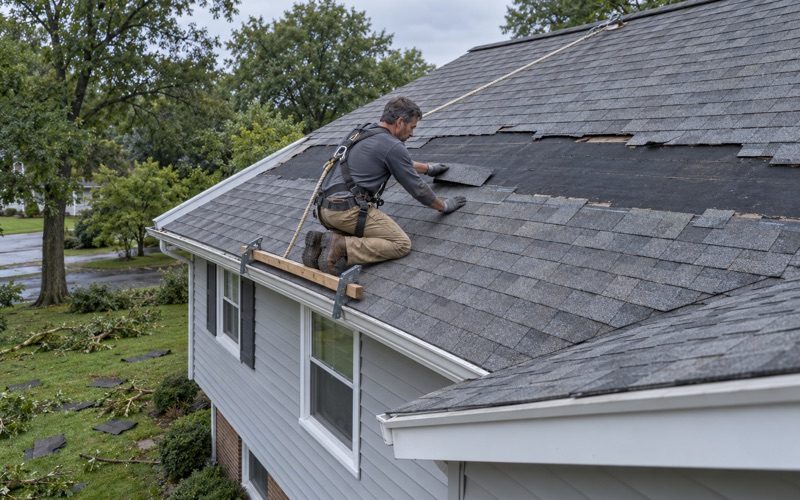
Census survey figures date 37.1% of the city’s housing units to 1939 or earlier. On roofs that age, a tear-off can uncover more than one old layer and soft decking at the eaves, and the state rehabilitation subcode calls for a full tear-off where two or more layers are already in place. Any damaged decking we find is photographed and shown to the owner before it is replaced, at a per-sheet price already written into the contract.
Ventilation gets the same attention on every replacement. A roof that cannot breathe ages from the underside, and older houses often have little intake at the soffits. We look at ridge vent and soffit intake together and size the net free area for the attic, rather than adding vents that never actually move air through it.
Paperwork and tax on a house job
Our contracts follow New Jersey’s home improvement rules, including the three-business-day cancellation right. Sales tax is stated the way the state treats each kind of job: a repair is taxable, while a new roof that qualifies as a capital improvement is exempt with Form ST-8. Owners see that difference on the quote before they sign, not on the final invoice.
When a storm damages a roof, we photograph it and write it up for the owner’s own insurance claim, and a crew member will meet the adjuster on site when asked. The claim itself stays between the owner and the insurer. At the end of each work day the driveway, yard and gutters are cleaned, with a magnet sweep for loose roofing nails.
The difference in plain terms
A landmark roof on the boardwalk is a phased commercial job run on public deadlines, with steel and masonry crews working alongside the roofers. A house re-roof in Asbury Park is a direct agreement between an owner and a contractor, usually finished in a few days. Knowing which kind of job you have tells you whose rules, schedule and paperwork apply before any work begins.
- 20+ Years on Roofs
- Itemized Written Scopes
- Attic-First Leak Checks