East Brunswick provides chimney repair in East Brunswick, NJ, serving surrounding cities including East Hanover, Highland Park, South Amboy, Metuchen and Aberdeen. In more than 20 years of tracing leaks, we have found that chimneys cause a large share of them, and the fault is split almost evenly between the flashing at the roofline and the masonry above it. Fixing only one side often leaves the leak in place.
Our chimney work focuses on keeping water out. That means step and counter flashing where the chimney meets the roof, crickets behind wide chimneys, and the crown, cap and mortar joints that protect the masonry from above. We check all of them on the same visit and price each repair separately.
Because chimney flashing is part of the roof, the best time to rebuild it is during a roof replacement. When the roof is sound, though, we can repair chimney flashing and masonry on their own without touching the rest of the shingles.
Chimney Flashing
Step Flashing Along the Sides
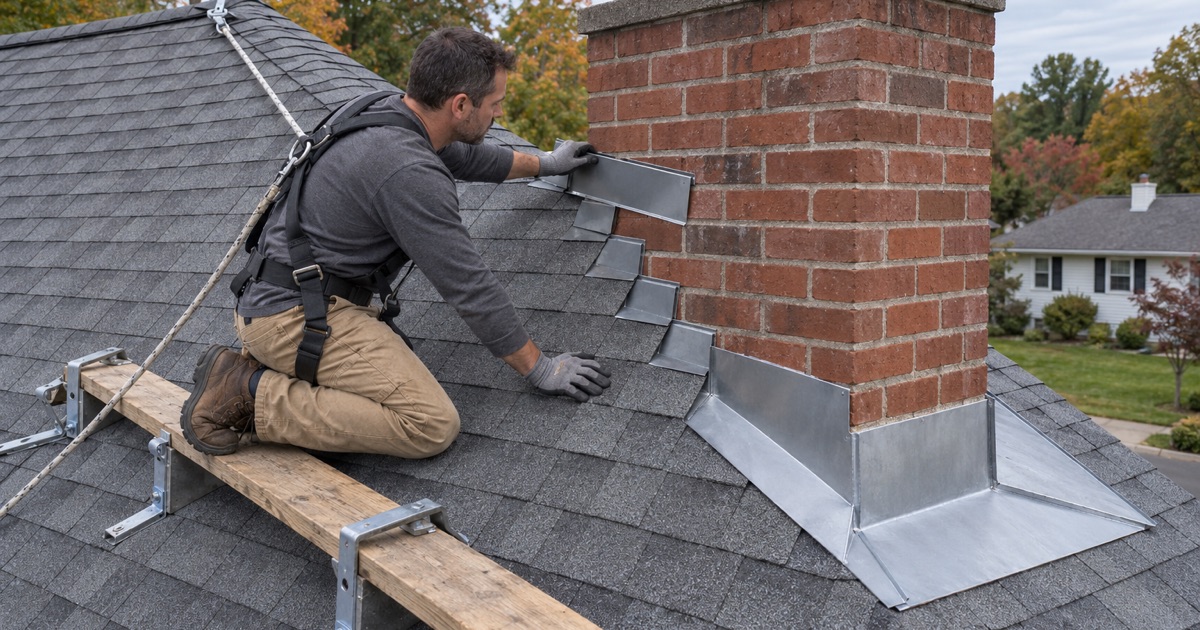
Step flashing consists of individual L-shaped pieces woven into each course of shingles along the sides of the chimney. Each piece overlaps the one below, so water running down the roof is directed back onto the shingles. When step flashing is missing or replaced with one long strip, water gets behind it at every course.
We install new step flashing with the shingles, tucked under each course and lapped correctly. On a repair, that means removing the shingles beside the chimney to rebuild the detail properly rather than adding sealant over the top.
Counter Flashing Set Into the Mortar
Counter flashing covers the top edge of the step flashing and is set into a reglet, a groove cut into a mortar joint. That way water running down the brick face cannot get behind the flashing. Many older chimneys have counter flashing simply caulked to the brick face, which fails as the caulk dries and cracks.
We cut proper reglets, set the counter flashing into them and seal the joint. The result is a detail that sheds water by design, not one that depends on caulk staying flexible for years.
Apron Flashing at the Front
The downhill face of the chimney gets a single apron flashing that laps over the shingles below. Its top edge is covered by counter flashing just like the sides. A torn or lifted apron lets water run under the shingles right at the front of the chimney.
We replace aprons with the rest of the flashing so all pieces fit together. Mixing old and new pieces is where gaps tend to open.
Crickets Behind Wide Chimneys
Why Wide Chimneys Need a Cricket
On the uphill side of a chimney, water and snow run straight into the back of the masonry and pile up. A cricket, also called a saddle, is a small peaked structure that splits that flow around both sides. Building codes require one behind chimneys wider than 30 inches.
Many older houses have wide chimneys with no cricket at all, which is why leaks so often start at the back corners. Adding one is one of the most effective chimney fixes we make.
Building and Flashing the Cricket
A cricket is framed on the roof deck, sheathed and covered with ice and water barrier before metal or shingles go on. Its valleys tie into the main roof, and its back edge is counter-flashed into the chimney. The detail must be built carefully because it carries concentrated water.
We usually build crickets during a roof replacement, when the area is open. They can also be added during a flashing repair on a sound roof.
The Masonry Above the Roof
Cracked Crowns
The crown is the concrete or mortar cap at the top of the chimney that sheds water away from the flue and the brick. Freeze-thaw cycles crack crowns over time, letting water into the masonry from above. That water can show up as staining inside the house or on the brick face.
Small cracks can be sealed, while badly broken crowns need to be rebuilt. A rebuilt crown should overhang the brick slightly so water drips clear of the chimney face.
Chimney Caps
A cap covers the flue opening and keeps out rain, animals and debris. An uncapped flue lets rain fall straight down the chimney, where it damages the flue and the damper. Caps also stop birds and squirrels from nesting inside.
We install caps sized to the flue and fastened securely so wind cannot lift them. On chimneys with multiple flues, a single cap can cover them all.
Repointing Mortar Joints
Mortar wears faster than brick, and open joints let water soak into the chimney. Repointing means grinding out the failed mortar and packing new mortar into the joints. Done properly, it restores the masonry’s ability to shed water.
We repoint the joints above the roofline when they have eroded, especially where counter flashing is set into them. Sound mortar is needed to hold the reglet and the flashing.
Spalling Brick
Bricks that flake or pop their faces, called spalling, have usually absorbed water that froze inside them. A few spalled bricks can be replaced, while widespread spalling may mean the chimney needs rebuilding above the roof. We describe what we see and give you the options.
Chimney Work With Roofing
Flashing Replaced With Every New Roof
When we replace a roof, chimney flashing is replaced too. Old flashing reused under new shingles is bent, nail-holed and often fails within a few seasons. Including new flashing in the replacement scope avoids tearing into a finished roof later.
Removing Unused Chimneys
Many houses have chimneys that no longer serve a fireplace or heating system. Taking an unused chimney down below the roofline and decking over the opening removes a leak point permanently. It is easiest during a re-roof.
Knowing Where Roofing Stops
Flue liners, sweeping and heating appliances are not roofing work. If we see signs of a problem inside the flue, we tell you so you can call a chimney sweep or heating contractor. Our focus stays on keeping water out at the roofline and above it.
- 20+ Years on Roofs
- Itemized Written Scopes
- Attic-First Leak Checks