East Brunswick provides commercial roofing in East Brunswick, NJ, serving surrounding cities including East Hanover, Highland Park, South Amboy, Metuchen and Aberdeen. For more than 20 years we have repaired and replaced roofs on retail strips, offices, warehouses, churches and apartment buildings. Most of those buildings carry low-slope membrane roofs, where drainage and flashing decide how long the roof lasts.
Commercial roofing comes with obligations a house roof does not. Re-roofing a commercial or multifamily building is permit work in New Jersey, tenants and customers have to be kept safe, and owners need documentation for leases, insurers and buyers. Our estimates address each of those in writing, along with the roofing itself.
We start with an inspection that covers the whole roof, not only the area over a reported leak. Clogged drains, open seams and failed flashing at rooftop equipment often share the blame for one stain on a ceiling tile.
Commercial Roof Systems
TPO and PVC Single-Ply Membranes
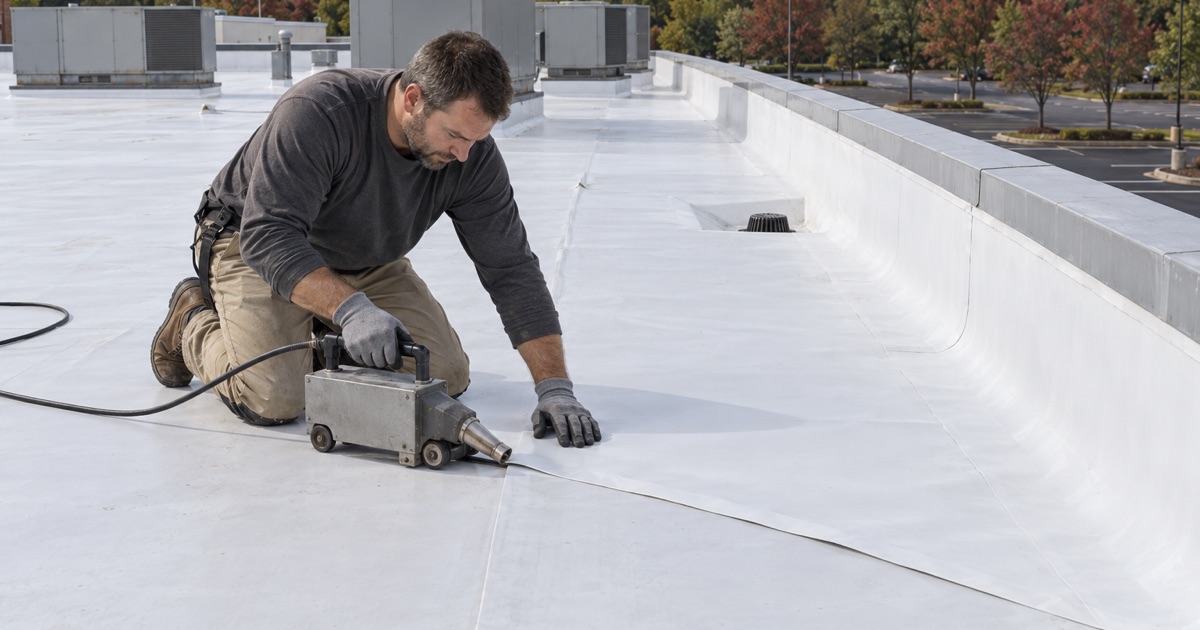
TPO and PVC are single-ply membranes with heat-welded seams, typically white or light gray to reflect summer heat. Welded seams form a continuous sheet, which makes them strong at the joints where many roofs fail. They suit retail buildings, offices and warehouses with large flat areas.
These membranes need care around penetrations and edges, where custom flashing is welded in place. We inspect seam welds during installation and repair, because a weak weld is the most common source of leaks on a single-ply roof.
EPDM Rubber Roofing
EPDM is a synthetic rubber membrane, usually black, used on many older commercial roofs as well as garages and additions. It handles temperature swings well and is straightforward to repair with compatible patches and seam tapes. Older EPDM roofs often fail at seams and flashing long before the field of the membrane wears out.
When an EPDM roof is aging, we compare repairing the seams and flashing against replacing the whole membrane. Many roofs have years of service left once their weak points are addressed.
Torch-Down Modified Bitumen
Modified bitumen comes in SBS and APP formulations, applied in layers with torches or adhesives. It is tough under foot traffic and works well around complex flashing details, which makes it common on smaller commercial buildings and mixed-use roofs. A granulated cap sheet protects the surface from sunlight.
Torch work requires fire-safety precautions, including a fire watch after the torches are off. On occupied buildings we plan torch work around tenants and choose cold-applied methods where open flame is not appropriate.
Coatings for Sound Membranes
Reflective coatings can extend the life of a sound membrane by sealing surface cracking and reducing heat absorption. They are not a repair for wet insulation, failed seams or ponding. We recommend a coating only after confirming the roof beneath is dry and structurally sound.
Drainage, Flashing and Equipment
Drains, Scuppers and Ponding Water
Water that sits on a flat roof for days speeds membrane aging and finds every weak seam. Clogged drains and scuppers are the leading cause, followed by sagging decks and roofs that were never sloped correctly. We clear and inspect every drain and note where ponding occurs.
Where ponding is persistent, tapered insulation during a re-roof can build slope toward the drains. That is often the single most valuable upgrade on an older flat roof.
Wet Insulation and Moisture Surveys
Water that gets under a membrane soaks the insulation board beneath it, and wet insulation loses most of its value while adding weight and feeding deck corrosion. A roof can look intact on the surface while large areas below are saturated. We probe and core suspect areas to find out how far the moisture has spread.
That survey decides the project. Small wet areas can be cut out and replaced as part of a repair, while widespread saturation means the roof should be torn off rather than covered. Knowing which before pricing keeps the owner from paying to seal water into the building.
Rooftop Units and Penetrations
HVAC units, exhaust fans, conduit and plumbing vents all pass through or sit on the roof. Each needs flashing compatible with the membrane, and each attracts maintenance traffic that can puncture the surface. We flash curbs and penetrations correctly and recommend walkway pads along common service routes.
Coordinating with mechanical contractors matters when units must be lifted or disconnected during a re-roof. We plan that sequence with the owner before work begins.
Parapet Walls and Edges
Parapet walls, copings and roof edges take the brunt of wind and weather. Loose coping caps and cracked wall flashing let water into the wall cavity, where it shows up inside far from the roof. We inspect and repair edge metal, coping and base flashing as part of every commercial job.
Working on Occupied Buildings
Retail, Office and Industrial Buildings
Open businesses need entrances clear, parking accessible and noise kept to sensible hours. We agree on a staging plan, dumpster location and work schedule with the owner before starting. Sections are kept watertight at the end of each working day so a sudden storm does not affect the space below.
Owners and managers receive photographs of the deck, the insulation and each completed stage. That record is useful for insurers, lenders and future buyers.
Apartment Buildings and Owner Duties
New Jersey’s maintenance code for multiple dwellings requires owners to keep roofs and leaders in good repair. Leaks in top-floor apartments affect tenants directly, so repairs are scheduled with tenant access and notice in mind. We document each repair so the owner has a record of maintenance.
Permits and Inspections
Commercial and multifamily re-roofs are permit work under the state construction code. We coordinate the permit application and schedule required inspections with the construction office. The estimate states the permit requirement plainly, so there are no surprises in the timeline.
Maintenance Plans
A flat roof that is inspected twice a year and cleared of debris lasts longer than one that is only looked at when it leaks. We offer scheduled inspections that cover drains, seams, flashing and equipment curbs, with a short written report after each visit. Small repairs found early rarely become large ones.
- 20+ Years on Roofs
- Itemized Written Scopes
- Attic-First Leak Checks