East Brunswick has handled roofing in East Hanover for more than 20 years, and a good share of what we look at here is not a house at all but a commercial roof over a row of storefronts. Owners, property managers and buyers call us when a leak shows up over a sales floor, when a lease renewal raises the question of roof life, or when a building is being readied for market.
Our first answer on any roof is whether it can be repaired, and we give it before replacement is ever put on the table. A low-slope roof over retail space often has years left in it once a failed seam, a split pipe boot or a tired perimeter flashing is fixed. When it does not, we say so plainly and explain the reasons.
When replacement is the right call, the written scope breaks out tear-off, decking, underlayment, flashing, ventilation and gutters as separate lines. That format lets an owner, a lender or a buyer’s consultant set our estimate beside another one and compare the two item by item, instead of comparing a pair of totals that hide what each price includes.
Commercial Roofing Along Route 10 in East Hanover
Where the Big Roofs Are
East Hanover is a Morris County township of about 11,000 people, and most of its homes are detached houses. The largest roofs in town, though, sit along Route 10, where one-story retail centers line the highway. Those buildings are bought, financed and sold as investments, and their roofs are treated as part of that investment rather than as a household chore.
That difference shapes how we work here. A homeowner’s decision is mostly about leaks and budget. A commercial owner on Route 10 is also weighing tenant leases, the value of the property at a future sale, and how the roof will read to anyone reviewing the building’s condition. We write our recommendations with all of those readers in mind.
What a Low-Slope Retail Roof Asks For
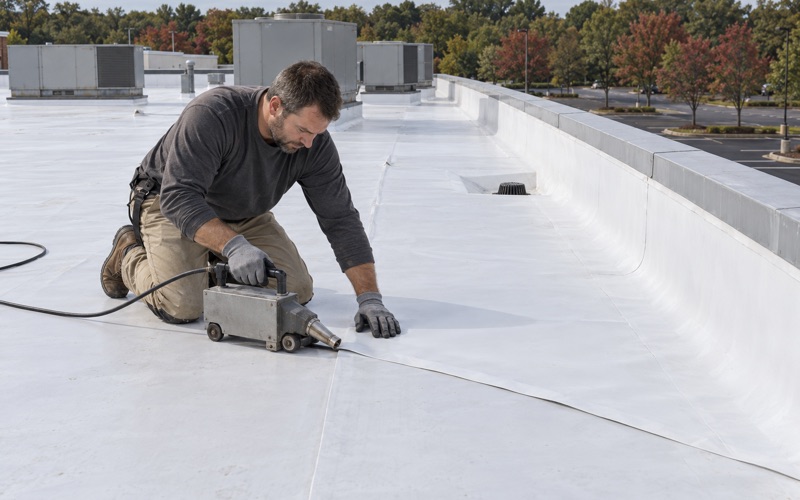
One-story strip centers are generally built with low-slope roofs, and that is the kind of roof we expect on this corridor, though we never assume what a particular building carries until we have been up on it. The common systems are EPDM rubber membrane, TPO and PVC single-ply membranes, and torch-down modified bitumen in SBS or APP form.
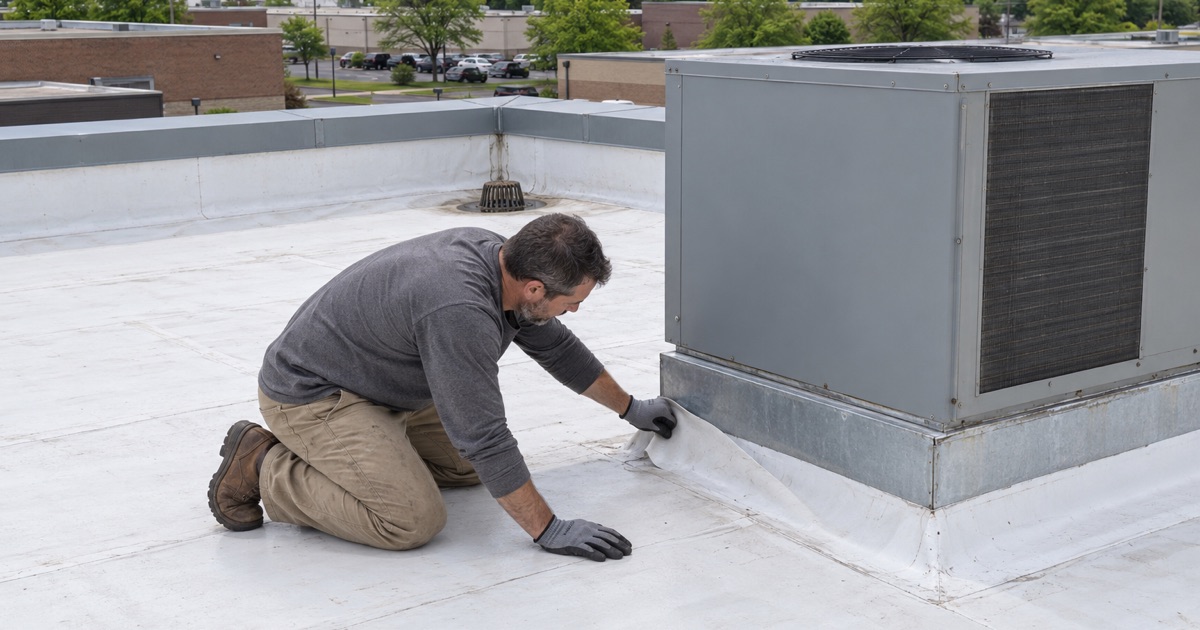
Each system fails in its own places. Single-ply membranes tend to open at seams and around penetrations, while modified bitumen shows its age at laps and at the base flashing where the roof meets a parapet wall. Rooftop equipment curbs, drains and scuppers are where we spend most of our inspection time on any flat roof.
Tracing a Leak Over a Sales Floor
Water on a flat roof can travel a long way under the membrane before it drips through a ceiling tile. A stain above a register counter may start at a drain thirty feet away. That is why every leak call includes a look from underneath, in the ceiling space above the store, as well as a walk across the roof itself.
Only after we know where the water enters do we price anything. Patching the spot directly above the stain is the most common wasted repair on commercial buildings, and it is the one we work hardest to avoid, because the tenant sees the drip return and the owner pays twice for the same leak.
Looking for roofing closer to Highland Park? See Roofing Services in Highland Park.
East Hanover Plaza and the Big-Box Corridor
A 98,020-Square-Foot Center
East Hanover Plaza at 154 Route 10 is the clearest example of what a roof on this corridor represents. The center covers 98,020 square feet and is anchored by HomeSense, HomeGoods and Sierra, three stores that together hold nearly 70 percent of its owned space. It was reported as fully leased, with Costco and Target as shadow anchors.
About 35,600 vehicles a day pass on the adjacent highway. A center with that kind of traffic and a full rent roll has a lot riding on a dry building, because a roof problem over an anchor tenant becomes a problem for the lease, the merchandise and the owner’s relationship with that tenant all at once.
When a Center Changes Hands
In November 2025, Real Estate NJ reported that SITE Centers sold East Hanover Plaza to Haverford Retail Partners as part of a $126 million portfolio spanning three states. We had no part in that transaction and have done no work at the plaza. Nothing published about the sale described its roof, and we would not guess at its covering, age or condition.
What the sale does show is how commercial roofs on this corridor are viewed. When a property trades, the buyer’s team looks at the roof as a capital item with a remaining life and a replacement cost. Owners who know that number before a buyer asks for it are negotiating from a stronger position.
What Shadow Anchors Mean for Roof Work
A shadow anchor is a large store next to a center that draws traffic without being part of it. Costco and Target bring shoppers into the area every day, which keeps neighboring parking fields busy from opening to close. For a roofing crew, that means there is rarely a quiet hour on site.
We plan around that traffic from the first site visit. Material deliveries, dumpster placement and the route our crew takes to the roof access all have to work with a lot that customers are actively using, which is a very different job from staging a tear-off in a residential driveway.
A Roof Upgrade Before a Sale: 346 Route 10
What the 2015 Sale Reported
At 346 Route 10, a 30,000-square-foot one-story strip with tenants including Party City, Verizon Wireless and Jersey Mike’s sold for $12.9 million in February 2015. NJB Magazine and NJBIZ reported that the seller had repositioned the property two years earlier with upgrades to the facade, parking, HVAC systems and roof.
That is all the reporting says about the roof. It does not name the system, the contractor or the cost, and it does not say what share of the price the roof accounted for. We did no work on that building. We cite it because it shows a roof listed beside parking and mechanical systems as part of preparing a property for market.
Preparing a Building for Market
When an owner is thinking about a sale, the question is not only whether the roof leaks today. It is whether the roof will get through a buyer’s inspection without turning into a price reduction. Sometimes the answer is a targeted repair with good documentation, and sometimes it is a full replacement finished well ahead of listing.
We give a straight answer on which one the building needs. For an owner planning a sale, we can also put the roof’s current condition in writing, as a report the seller can hand to the buyer’s inspector or consultant, so the conversation about the roof starts from what is actually up there rather than from assumptions.
Coordinating the Roof With HVAC Work
At 346 Route 10, the roof and HVAC were upgraded in the same repositioning, which is a common pairing. Rooftop units sit on curbs that are flashed into the roof, and replacing a unit without addressing its curb, or re-roofing without planning for the units, leaves a weak point that tends to leak first.
When an owner is replacing mechanical equipment and the roof in the same period, we coordinate the sequence with the HVAC contractor. Curbs get new flashing as part of the roof rather than old flashing reused under new membrane, and the units go back onto a roof that is ready to carry them.
Decking Surprises Under an Old Roof
Once an old roof is off, the deck underneath sometimes tells a different story than the surface did. Rusted metal deck or soft wood sheathing around a long-running leak is common on older buildings, and it cannot be judged until it is exposed.
When we find damaged decking, we photograph it and show the owner or property manager before anything is replaced. The price for that work is set per unit in the contract ahead of time, so a discovery on the roof never becomes an open-ended change order.
Permits and Scheduling Around Open Stores
Commercial Re-Roofs Are Permit Work
New Jersey’s construction code treats roof covering on detached one- and two-family houses as ordinary maintenance under N.J.A.C. 5:23-2.7. That rule does not extend to a retail center. Re-roofing a commercial building on Route 10 is permit work handled through the East Hanover Township construction office, and the township’s offices are at 411 Ridgedale Avenue.
Every estimate we write says plainly whether the job is permit work under the state construction code. For a commercial roof it is, and the schedule we propose accounts for the permit and the inspections that come with it rather than treating them as an afterthought once the crew is ready to start.
Working While the Doors Are Open
Retail tenants rarely close for a roof. The work happens above a sales floor that stays open, so we plan tear-off in sections that can be dried in the same day. No section of the roof is opened that cannot be closed again before the crew leaves or before weather arrives.
Noise, odor and vibration matter too. Torch-applied and adhesive-applied systems each bring their own considerations for occupied space, and we talk through the choice with the owner and, where needed, the tenants before work begins. Early starts can keep the loudest work ahead of the busiest shopping hours.
Parking Lots, Deliveries and Customer Safety
On a busy center, the parking lot is part of the job site. We fence off the staging area, keep the dumpster and material drop away from store entrances and drive aisles, and work with the property manager on delivery times that do not collide with tenant trucks.
At the end of each work day, the lot around our staging area is cleaned, including a magnet sweep for roofing nails and fasteners. A screw in a shopper’s tire becomes a complaint to the tenant and then to the owner, and it is an entirely avoidable one.
Drainage on a Flat Roof
Low-slope roofs move water to interior drains, scuppers and gutters, and a replacement is the time to make sure that path works. We check drain bodies and strainers, confirm scuppers still sit at the right height once new insulation goes down, and size gutters and leaders so water leaves the building instead of pooling on the walk below.
- 20+ Years on Roofs
- Itemized Written Scopes
- Attic-First Leak Checks