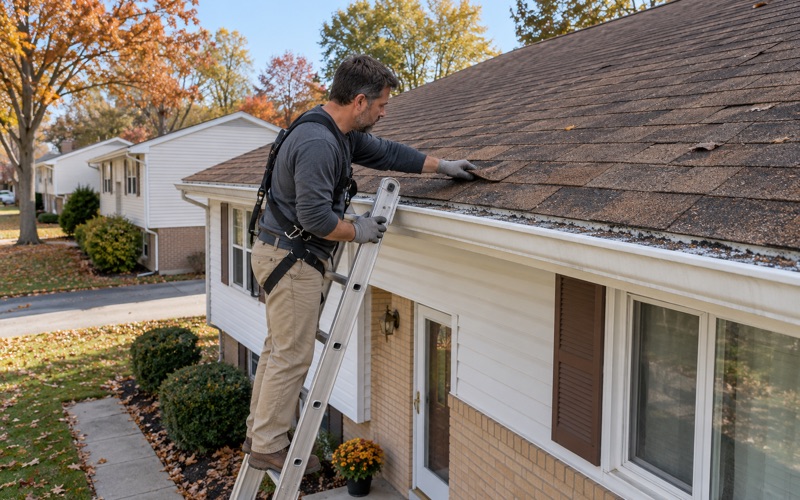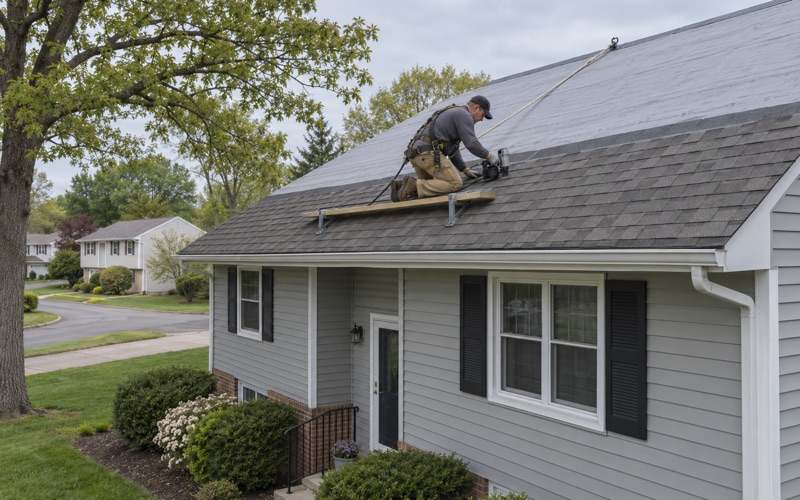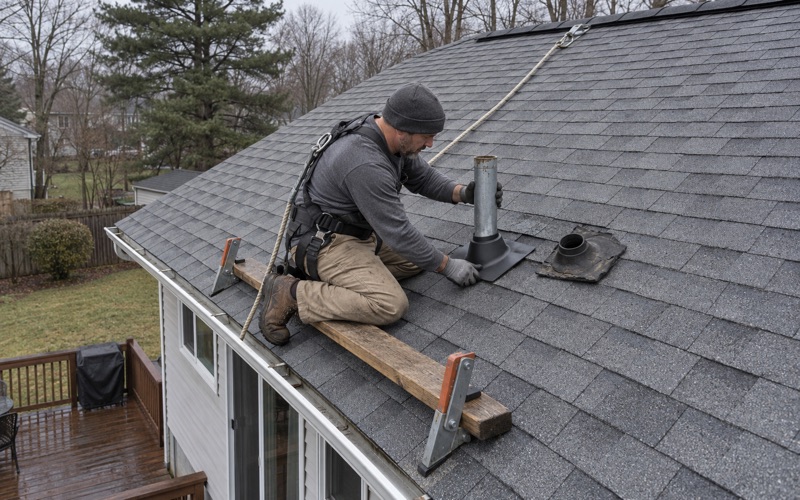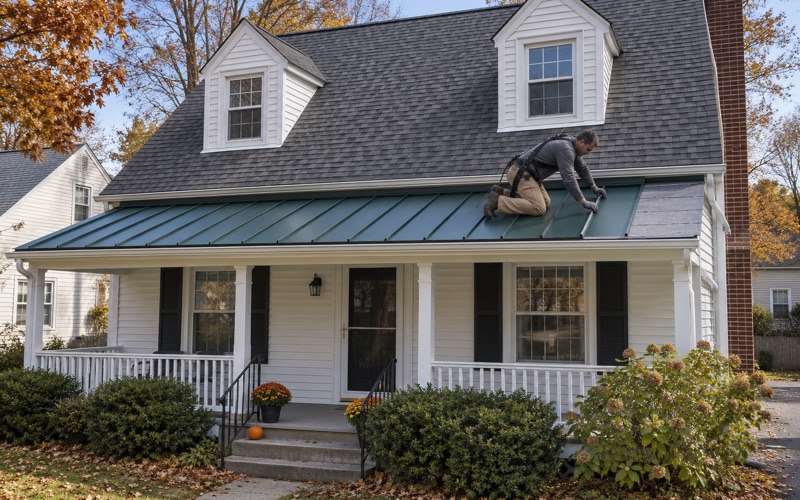
East Brunswick brings more than 20 years in the trade to roofing in Hanover, and we start every leak call in two places at once: on the roof and up in the attic. A ceiling stain rarely sits directly under the opening that caused it, so we follow the water back along rafters and sheathing to where it really gets in. Nothing gets priced until that path is known.
The next thing you hear from us is a plain answer about repair. If a flashing joint or a handful of shingles is the problem, we say so before replacement ever comes up. When a roof has reached the end of its life, the written scope breaks out tear-off, decking, underlayment, flashing, ventilation and gutters as separate lines, so a second estimate can be laid beside ours and compared item by item.
Much of what we look for here comes down to how a house grew. A home that gained a bedroom wing, a dormer or an enclosed porch over the decades usually carries a roof built in more than one season, and the joints between those pieces are where trouble starts. Small lots add a second question, which is where a crew can stand materials without crowding a neighbor.
Roofing in Cedar Knolls, a Neighborhood Platted in 1913
Cedar Knolls is one of the two unincorporated communities inside Hanover Township in Morris County, alongside Whippany. Its story as a place to live starts with a subdivision map, and that map still explains a lot about what we find when we climb a ladder there.
374 Lots North of Ridgedale Avenue
Menko Wolfe bought the 114-acre Charles Ford Estate and filed a subdivision map with the Morris County Clerk on December 16, 1913. The plan laid out three roads, six avenues and 374 housing lots on the north side of Ridgedale Avenue, which was then called Morristown Road. Its bounds ran from Fairview Avenue to Mountain Avenue and from Morristown Road to North Belair.
That is a lot of parcels drawn onto one estate, and the pattern shows in the way houses sit close to their neighbors. A local history describes Cedar Knolls as primarily residential, with attractive housing on small fertile lots, and calls it the highest community in the township. For a roofer, the lot sizes matter more than the view.
From Summer Camps to Year-Round Houses
In 1914 Bertha Wolfe’s W-B Camp and Bungalow Company began marketing the land as summer homes, camps and bungalow plots, on quarter-, half- and one-acre lots starting at $100. The pitch was Cedar Knolls in the Mountains. By 1916 the company had built and sold more than 50 bungalows, 300 people spent the summer there, and 100 lived there year-round.
The neighborhood kept filling in. The Monroe station was renamed Monroe-Cedar Knolls in 1918, the fire company followed in 1919 and the post office in 1923. A place that began as seasonal camps became a full-time address, and a century of different owners has shaped the houses since.
What a Bungalow Start Can Mean for a Roof
We have not surveyed which early bungalows survive or how each house was enlarged, and we do not assume any particular home began as one. What the history does suggest is a reason to look carefully. A house on a lot drawn for a summer camp may well have been enlarged in stages, and every stage that changed the roofline left a seam.
So a Cedar Knolls roof estimate from us starts with a walk around the outside and a look at the attic framing. Changes in rafter size, sheathing type or ceiling height inside often mark where one building period ends and the next begins. Those lines tell us where to look hardest once we are up top.
Looking for roofing closer to Clinton Township? See Roofing in Clinton Township.
Where Newer Roof Sections Meet Older Ones
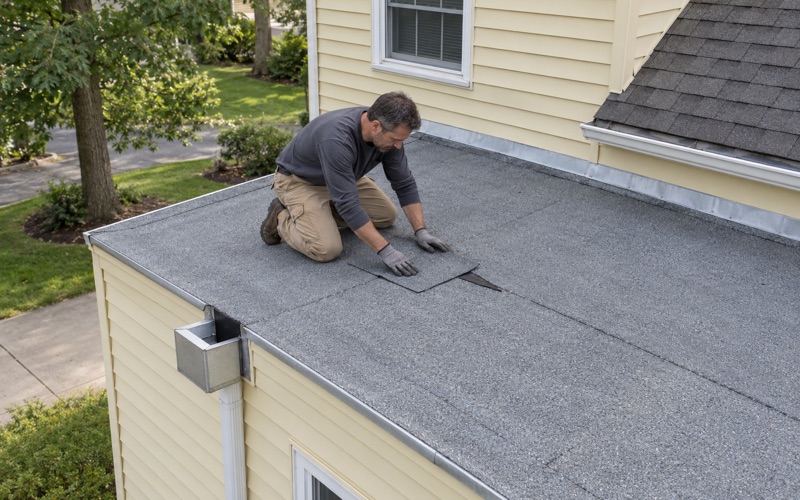
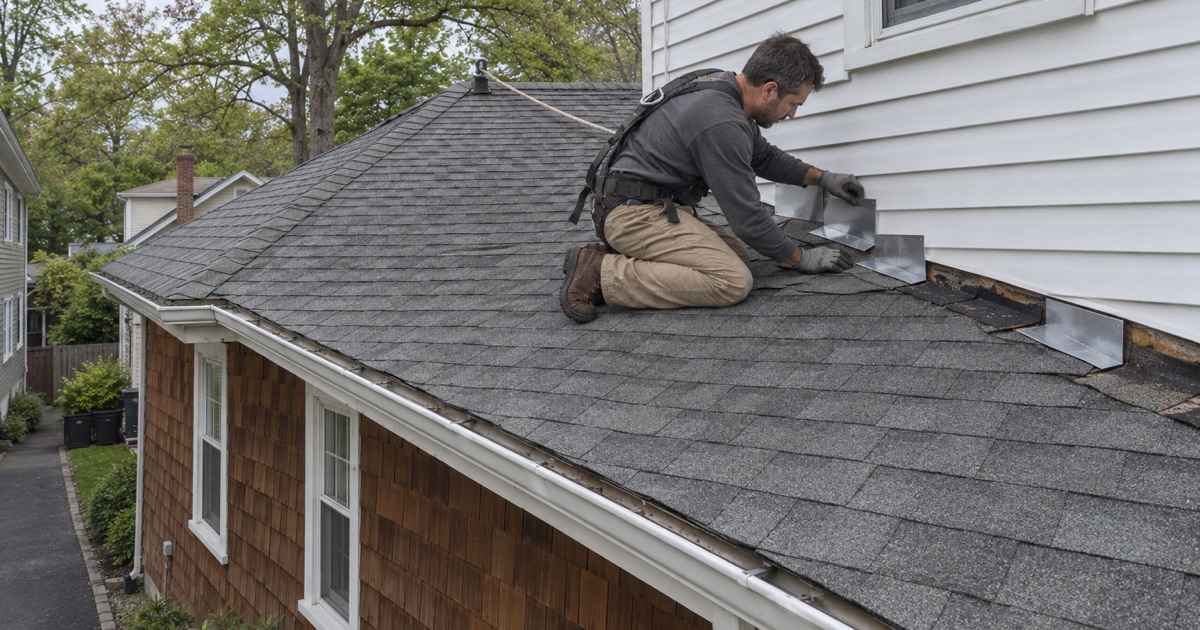
A tie-in is the joint where an addition’s roof meets the roof it was built against. Done well, it sheds water like any other part of the slope. Done in a hurry, it is one of the first places we check when a leak shows up in a house that grew over time.
Finding the Seams Before Pricing Anything
Valleys where two roof planes meet at odd angles, a dormer cheek that butts into an older slope, a shed roof tucked under a second-story wall: each of these joints needs its own flashing plan. We map them during the inspection and note which ones show staining underneath, so the estimate addresses real water paths instead of guesses.
Sometimes the two sections were framed at different pitches or with different overhangs, which leaves a step or a dip where the shingles change direction. We point those spots out in writing. A clear picture of the seams is also what lets us give an honest answer about whether one section can be repaired while another waits.
Flashing at Every Tie-In
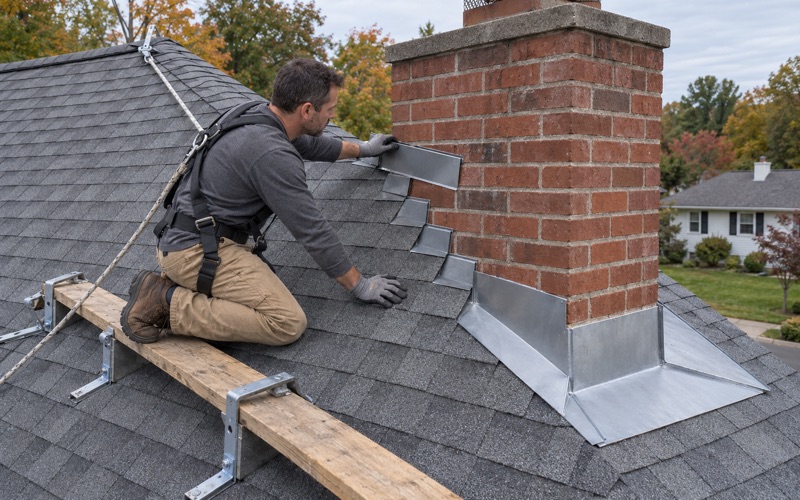
On a replacement, step flashing, counter flashing and chimney flashing come off with the old roof and go back new rather than being reused under fresh shingles. Where an addition’s sidewall meets a lower roof, we install kick-out flashing at the bottom of the run so water lands in the gutter instead of soaking the wall behind the siding.
Apron flashing goes across the face where a lower roof meets an upper wall, and counter flashing set into a reglet covers the top edge of the step pieces on masonry. Drip edge runs along the eaves and rakes of every section, old and new. A roof assembled from several eras should come out the other end reading as one continuous system.
Decking and Ventilation Under a Pieced-Together Roof
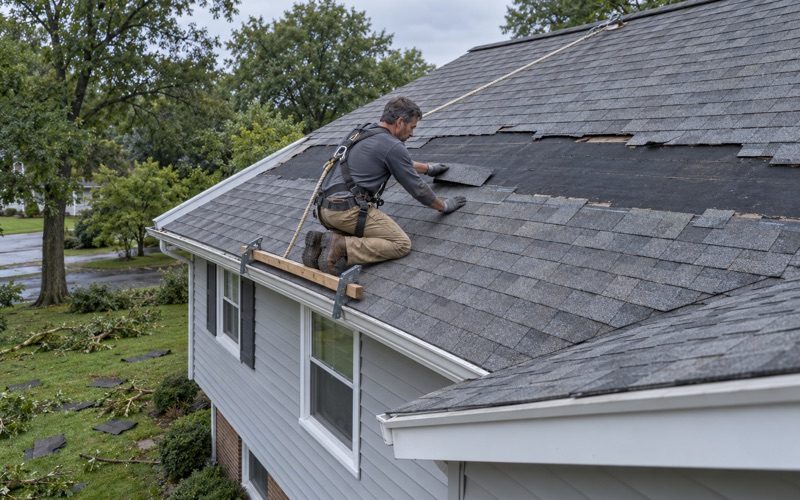
Once the shingles are off, decking on an older section can look nothing like the sheathing over a later addition. Any damaged decking we find is photographed and shown to you before it is replaced, at a per-sheet price already written into the contract. You see the board before you pay for it.
Ventilation gets checked on every replacement, and it needs extra attention when separate sections have separate attic spaces. An addition with no clear path to the main ridge can trap heat and moisture even if the rest of the house breathes well. We look at soffit intake and ridge vent together, because a roof that cannot breathe ages from underneath.
Working on Small Lots Between Fairview and Mountain Avenues
The blocks laid out between Fairview Avenue and Mountain Avenue were drawn as small parcels, and that shapes the logistics of a tear-off as much as the roof itself does. We plan the staging before the crew arrives.
Staging Materials Without Taking Over the Yard
On a tight lot there may be one good spot for the dumpster and one for the shingle delivery, and sometimes they are the same spot. We walk the property with you first, agree on where bundles land and where debris goes, and protect plantings, air conditioning units and walkways that sit close to the drip line.
Where the side yard is narrow, tear-off is handled in sections so debris goes straight into the container rather than piling up against the house or a neighbor’s fence. Ladders and roof jacks are placed so the crew can work safely without needing space the lot does not have.
Daily Cleanup and the Magnet Sweep
At the end of each work day the driveway, yard and gutters are cleared, and the crew runs a magnet sweep over the lawn and pavement for loose roofing nails. On a small lot the cleanup covers your neighbor’s side of the property line too, since that is often where stray debris lands.
Nothing is left on the roof overnight that could blow loose, and any open section is covered before the crew leaves. A multi-day job on a crowded block should never leave a family stepping around shingle scraps on the way to the car.
Gutters, Leaders and Where the Water Goes
A roof that grew in stages often ends up with gutters that grew the same way, with short runs, mismatched leaders and downspouts that empty right beside the foundation. We size and pitch seamless aluminum gutters and leaders with the roof, so the water leaves the house instead of pooling where it can find a basement.
Hanover sits in National Weather Service forecast zone NJZ008, covered by the Mount Holly office, and the Whippany River runs through the township. Flooding from Hurricane Irene destroyed the Whippany post office in 2011. Getting roof water off a small lot and away from the house is part of the roof job here, not an afterthought.
Paperwork, Permits and Pricing in Hanover Township
Every estimate we write says plainly whether the job is permit work under the state construction code. Replacing the roof covering on a detached one- or two-family house counts as ordinary maintenance in New Jersey, so a straightforward shingle replacement on a detached home does not need a permit.
Attached Homes and Association Roofs
Hanover’s housing is more mixed than a quick drive suggests. The Census Bureau’s 2024 five-year estimates count 3,782 detached houses in the township alongside 745 one-unit attached homes and 1,051 units in buildings of five or more. Re-roofing on attached and multifamily buildings falls outside the detached-house maintenance rule, so we check the permit question separately for those.
In townhouse and condominium communities we also check who holds the roof against the association’s documents before writing any estimate. If the association is responsible, we say so up front rather than pricing a job you should not be paying for. Questions for the township go to Hanover Township Building and Zoning at 1000 Route 10 in Whippany.
Contracts and Sales Tax
Our contracts follow New Jersey’s home improvement rules, including the notice of your three-business-day right to cancel. Quotes treat sales tax the way the state does: a repair is taxable, while a new roof that qualifies as a capital improvement is exempt with Form ST-8. Seeing that difference on paper keeps a repair-versus-replace decision honest.
If you are selling the house, we can write a roof condition report you can hand to the buyer’s inspector. It records the materials, the age of each section where it can be determined, and the condition of the flashing and tie-ins, which is exactly what a buyer will ask about on a house that has been added onto.
Storm Damage and Your Claim
After a storm we photograph the damage and write it up for your own claim, and when you ask, the crew will meet your insurance adjuster on site to walk the roof. The claim stays yours to file and settle. What we bring is a clear record of what the wind or hail did, section by section.
That record matters most on a roof assembled in stages, where an older slope and a newer one can weather differently in the same storm. Documenting each section separately helps an adjuster see which damage is new and which is long-standing wear.
- 20+ Years on Roofs
- Itemized Written Scopes
- Attic-First Leak Checks