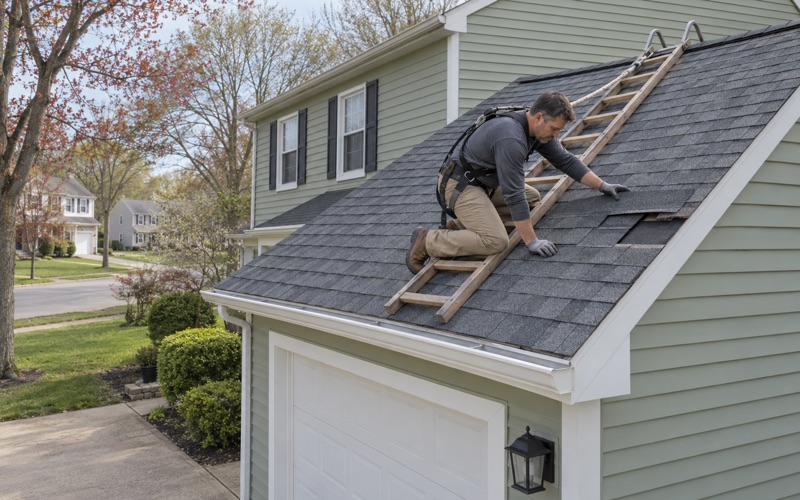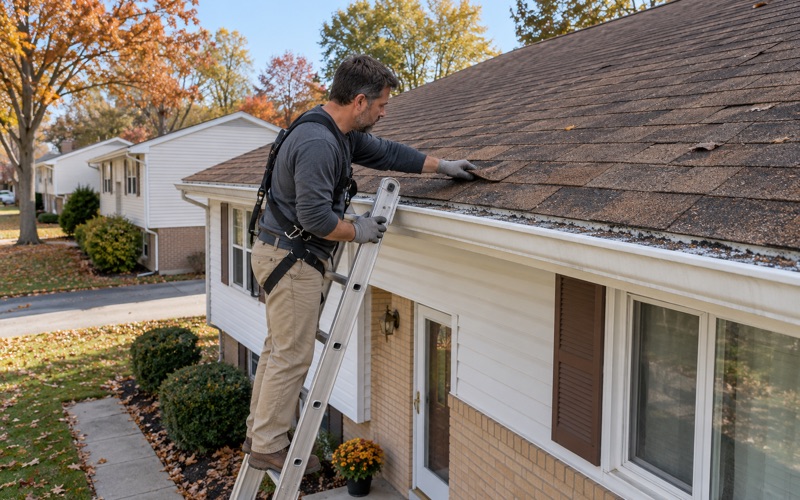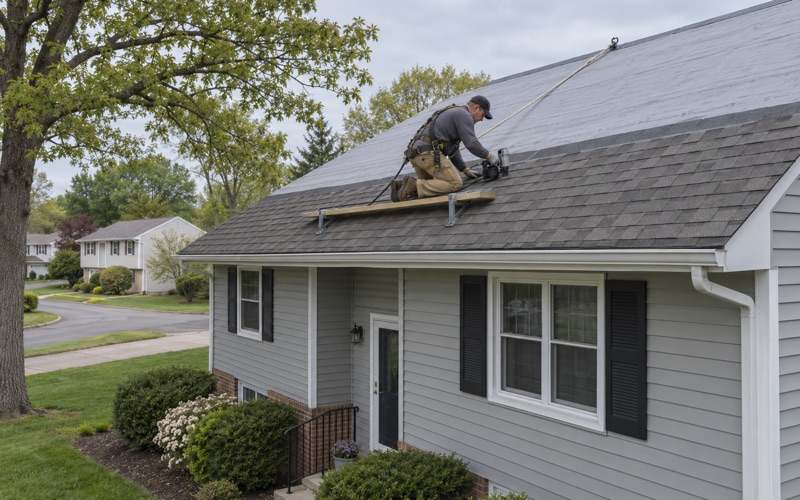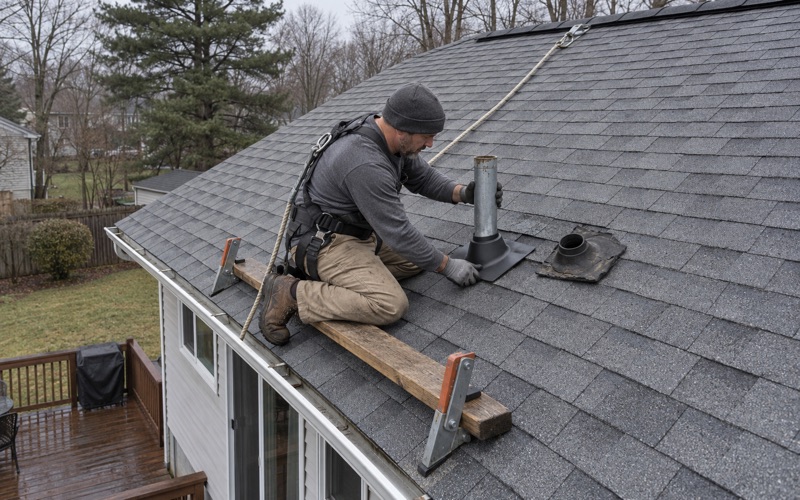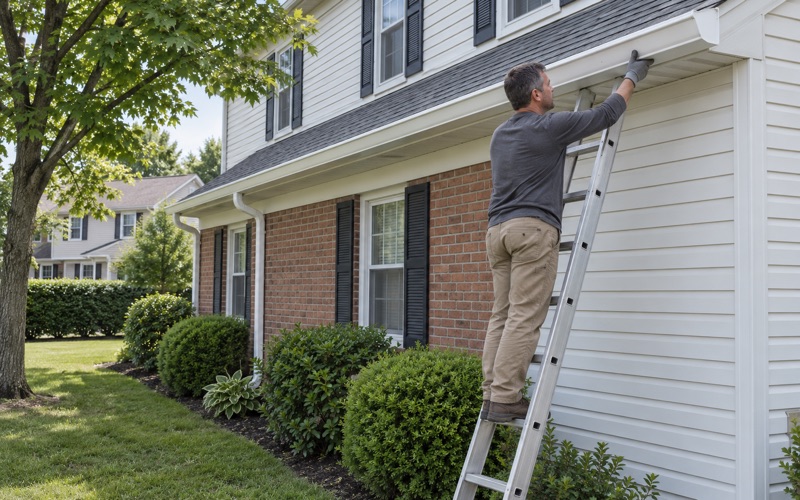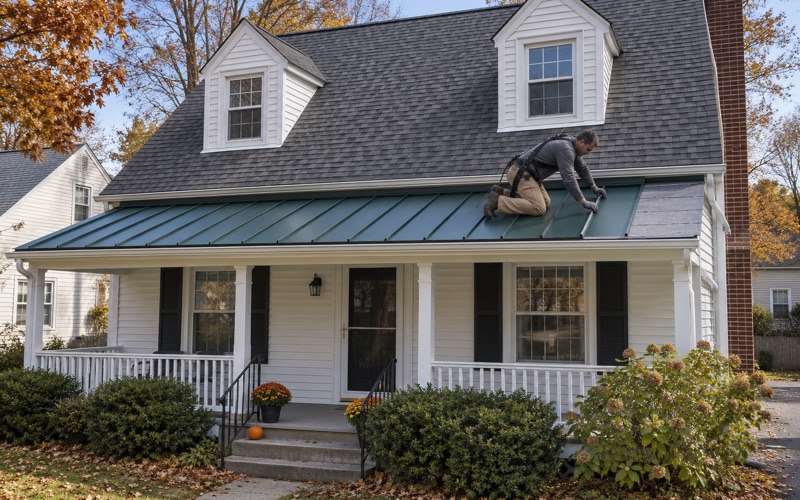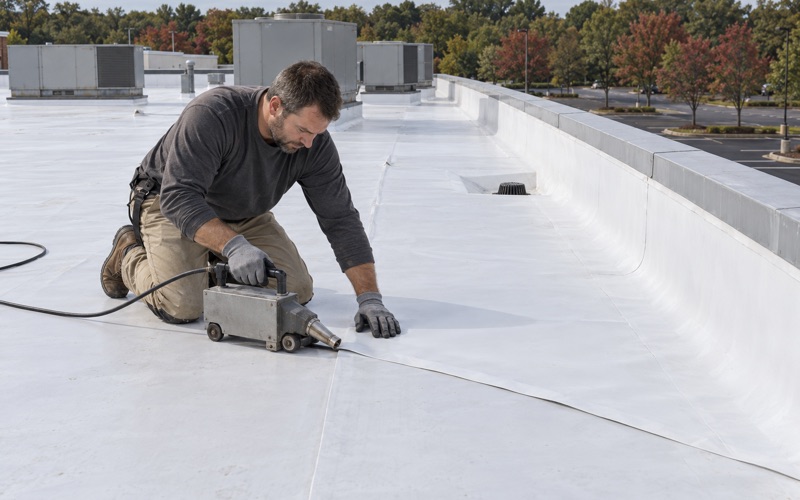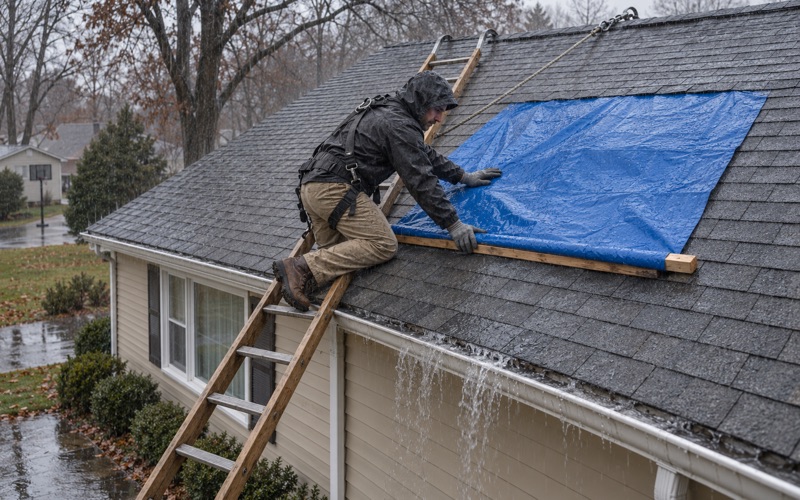
East Brunswick handles roofing in Manville with more than 20 years in the trade behind every estimate we write. When a ceiling stains, we look in the attic as well as on the roof, so the water is followed to the spot where it actually enters before a single line gets priced. That habit keeps a small repair from being sold as a new roof.
Our first answer is always whether the existing roof can be repaired. Replacement only enters the conversation after that question has a straight reply, and when it does, the written scope breaks tear-off, decking, underlayment, flashing, ventilation and gutters into separate lines. Two estimates set side by side can then be compared item by item instead of as two totals.
This page is about one part of the borough where the roof is the easy half of the job. On some lots, the work that carries water off the roof and into the ground deserves a closer look before anyone picks up a shovel. We would rather explain why up front than discover it halfway through a project.
The Claremont Development: Early-1960s Houses Over a Former Creosote Works
The Claremont Development in Manville is a 35-acre neighborhood of 129 single-family houses, and its history sets it apart from the rest of the borough. From 1919 until 1956 the Federal Creosoting Company treated railroad ties and poles on this ground. In the early 1960s, homes and a commercial mall were built on top of that land, and the creosote materials below were not removed first.
A wood-treating site that became a neighborhood
The EPA’s 2021 five-year review describes two unlined sludge lagoons and connecting canals beneath the residential section. In places the lagoons sat as shallow as two to five feet below the surface, and elsewhere they reached 25 to 35 feet deep. The commercial strip built alongside the houses became the Rustic Mall, which was folded into the same cleanup.
For roofing, that history matters in one narrow way. Nothing about it touches shingles, decking, underlayment or flashing, and a crew working on the roof never comes near it. It concerns the soil, and on a typical house the only roof-related work that reaches the soil is the drainage that carries rainwater away from the foundation.
How the federal cleanup reshaped the street
The Federal Creosote site was added to the national Superfund list on January 19, 1999. Over the following years the EPA remediated 93 residential properties, excavating anywhere from 1 to 35 feet deep and removing more than 260,000 tons of soil from the residential development. Eighteen homes were acquired and demolished where the deepest material sat.
The cleared lots did not all stay empty. Eight properties from the first phase were sold to a residential developer and rebuilt as single-family housing, and two more from a later phase were redeveloped the same way. Eight lots over the northern lagoon and canal, excavated to 35 feet, are owned by the Borough of Manville and still await redevelopment.
A cleanup the EPA considers finished
The site has since been deleted from the Superfund list, and the EPA judges the remedy protective. Work at the Rustic Mall ran from 2005 into early 2008. We bring up the history not because a Claremont house needs special handling on the roof, but because one document tied to that cleanup can shape the drainage side of a roofing job.
Looking for roofing closer to Hanover? See Hanover Roofing.
Rebuilt Lots, Original Houses and 21 Deed Notices
Walk the Claremont Development today and two generations of house stand side by side: the early-1960s originals that came through the cleanup, and newer single-family houses on lots that were cleared and rebuilt. They ask different things of a roof crew, and the paperwork recorded against each lot can differ as well.
What the 2008 deed notices are
The EPA review records that residual contamination above the cleanup goals was left beneath 21 properties, and each of those properties carries a deed notice filed in August 2008. The review lists their purpose as preventing direct contact with soil containing residual contamination. For 15 of the 21, that material lies shallower than 14 feet.
We do not know which properties those are, and we would not publish it if we did. What matters to a homeowner is simpler: a deed notice is recorded with the property, so your deed and title paperwork will show whether your lot carries one. Before we price anything that goes into the ground, we ask about it and read it first.
Early-1960s originals
The original Claremont houses are now more than 60 years old, and many have been re-roofed at least once. On those, we check how many layers sit on the deck, how the eaves were framed, and whether the attic has real intake and exhaust. Where two or more layers are already on, the state rehabilitation subcode calls for a tear-off rather than another overlay.
Attic ventilation gets checked on every replacement we write, because a roof that cannot breathe ages from underneath. Painted trim and fascia on a house built before 1978 also fall under the EPA’s lead-safe renovation rule, so fascia or rake work on an original house is planned that way from the start. Gutter hangers often fasten through that same fascia, which ties trim, gutters and roof into one scope.
Post-cleanup rebuilds
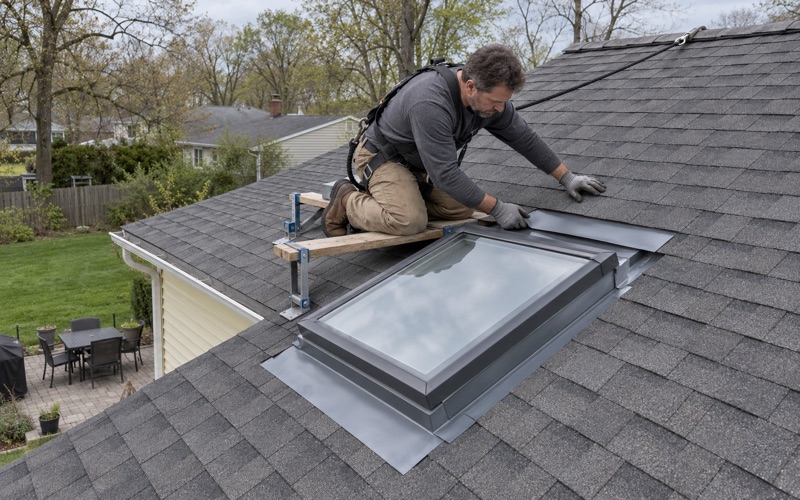
The newer houses on cleared lots are a different job. Their roofs are younger, their decking is usually sound, and the questions tend to be about a specific leak, a skylight or a section of flashing rather than a full tear-off. A leak call on one of these gets the same attic-and-roof inspection, and it often ends in a repair rather than a quote for new shingles.
Roof Work Stays Above Ground; Drainage Work May Not
Almost everything on a re-roof happens between the eaves and the ridge. Tear-off, decking, underlayment, flashing and shingles never touch the yard. The exceptions are the pieces of a roof job that send water somewhere, and on a Claremont lot those are the pieces we stop and look at before quoting.
What a tear-off actually involves
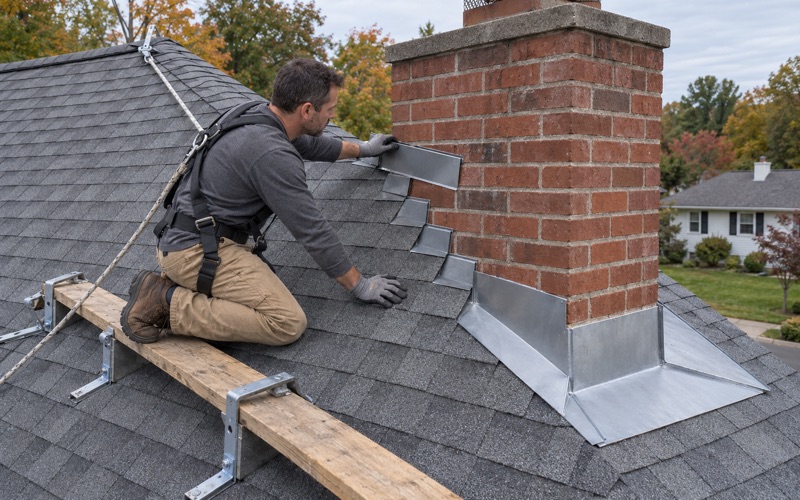
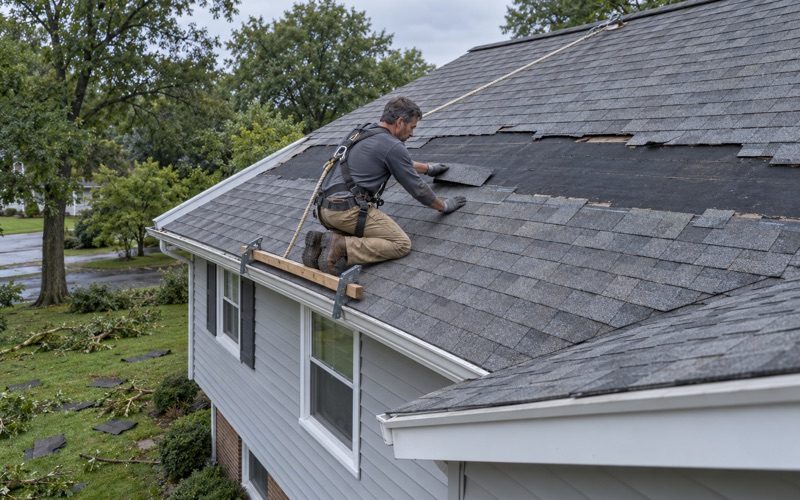
On a full replacement, the old roofing comes off into a dumpster or lined trailer, and the deck is inspected sheet by sheet. Any rotted sheathing is photographed and shown to you before it is replaced at the per-sheet price written into the contract. Step, counter and chimney flashing are replaced with the roof instead of being reused under new material.
None of that reaches below grade. At the end of each work day the driveway, yard and gutters are cleaned, and the lawn gets a magnet sweep for roofing nails. Daily cleanup happens on the surface and involves no digging, so it runs the same way on every street in Manville.
Where a roof job turns into digging
The digging part of a roof job is drainage. Some homeowners want leaders piped underground to the curb or to a drywell instead of splashing beside the foundation, and others ask us to replace an old buried line that has clogged. That trenching is routine on most lots in the borough, and it is exactly where a Claremont property’s deed notice should be read first.
We do not interpret what a deed notice says about any particular trench. That reading belongs to the document itself and to whoever administers it, not to a roofer’s guess. What we can do is keep the roof work and the drainage work on separate lines of the estimate, so a question about one never holds up the other.
Permit questions on the roof itself
Replacing the roof covering on a detached one- or two-family house is ordinary maintenance under New Jersey’s construction code, which means no permit, inspection or notice to the borough building department. Every estimate we write says plainly whether the job is permit work. A straightforward tear-off is not, so the roofing paperwork for a Claremont house matches any other detached home in Manville.
Gutters, Leaders and Where the Water Goes on a Claremont Lot
Gutters are where the roof and the ground meet, so this is the part of the job we plan most carefully in this neighborhood. The goal is the same as on any house: water should leave the roof, travel the gutters and leaders, and end up away from the foundation. The difference is in how it gets there.
Sizing and pitching gutters with the roof
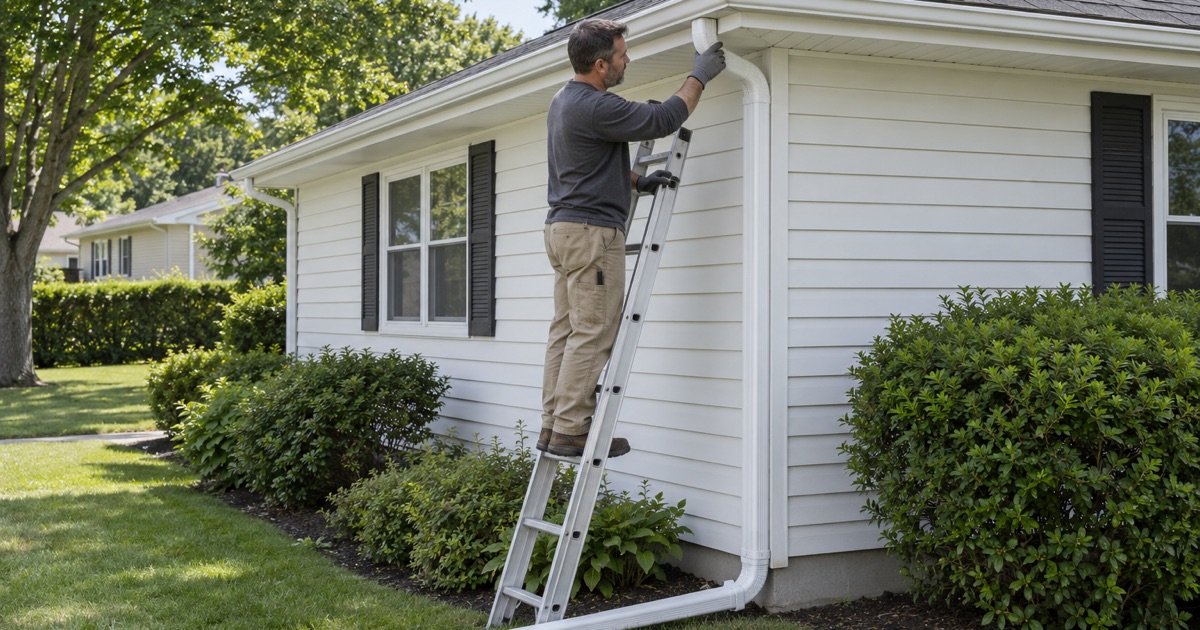
We size and pitch gutters and leaders as part of the roof, not as an add-on once the shingles are down. Seamless aluminum gutters are run to the length of each eave, the drip edge is set to hand water into them, and the number of leaders is matched to the roof area each one has to drain.
A gutter that is too small, or pitched the wrong way, overflows at the corners and dumps water straight down the siding. On an older house, that water lands near the foundation and soaks the soil against the basement wall. Getting size and pitch right on the roof side solves much of the problem before any drainage question comes up.
Discharge at grade versus buried leaders
Leaders and downspouts can discharge at grade through an extension or splash block that carries water several feet out from the wall. That option involves no digging at all, and on a Claremont lot it is often the simplest way to finish a gutter job. When a homeowner wants the water carried farther, or out of sight, the conversation moves to buried pipe.
Buried leaders and drywells are where we pause. We quote them as a separate line from the gutters, and on a property with a deed notice, the notice is read before that line is scheduled. If the answer takes time, the roof and gutters can still go ahead with at-grade discharge, and any buried work can follow once it is settled.
A written scope you can compare
Every quote lists tear-off, decking, underlayment, flashing, ventilation and gutters on their own lines, with any drainage work broken out separately. Our contracts follow New Jersey’s home improvement rules, including the three-day cancellation notice. Sales tax is stated the way the state treats each job: taxable on a repair, and exempt on a new roof with Form ST-8.
If you are selling an original Claremont house or one of the rebuilds, we can also prepare a written roof condition report to hand to the buyer’s inspector. It describes the roof, the flashing, the gutters and where the leaders discharge, so the drainage question is answered on paper before it surfaces during the sale.
- 20+ Years on Roofs
- Itemized Written Scopes
- Attic-First Leak Checks