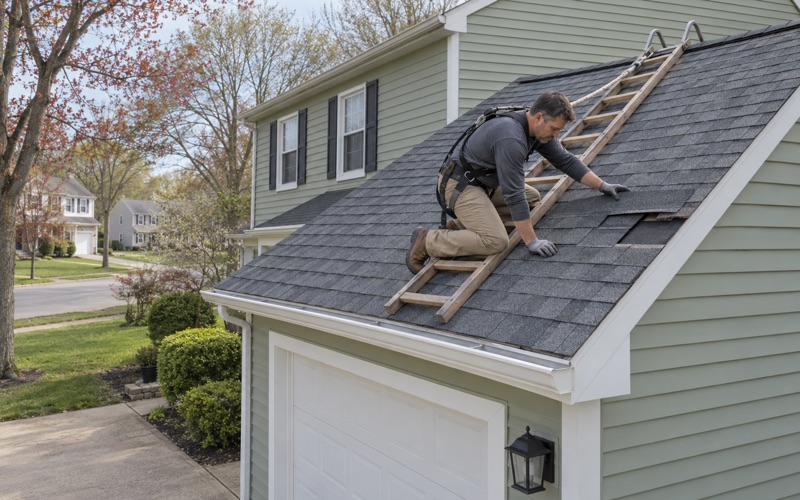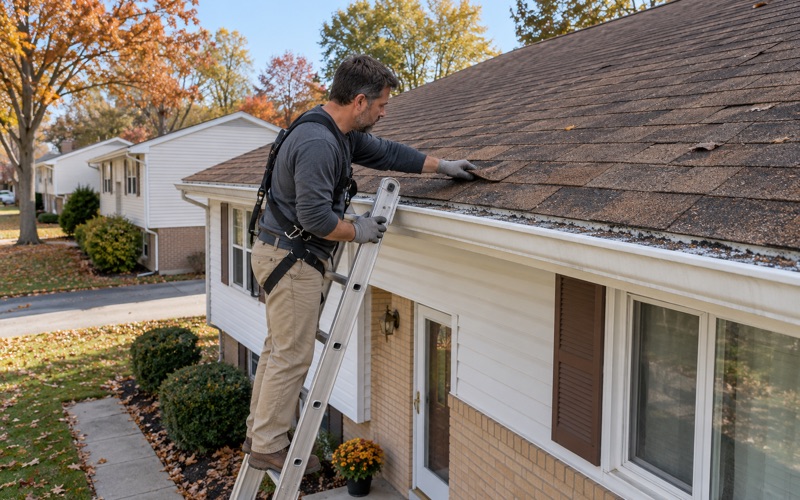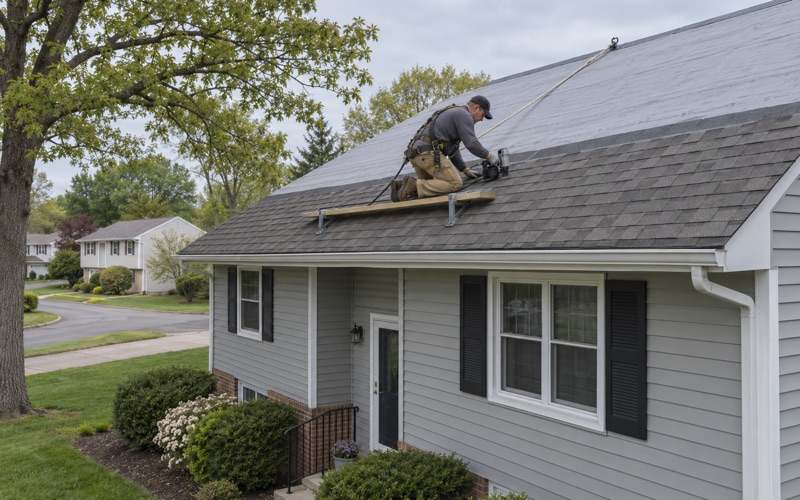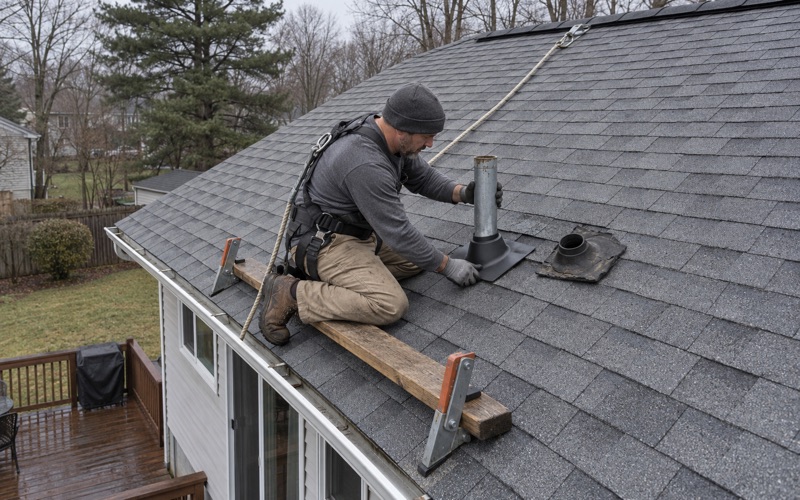
East Brunswick handles roofing in New Providence for homeowners who want the chimney treated as part of the roof rather than an obstacle the shingles have to work around. With more than 20 years on New Jersey roofs, we start every leak call in the attic as well as up top, so the water is traced to where it actually gets in before a single line is priced.
That habit matters most around a chimney. A stain on the ceiling beside the flue can come from failed step flashing, a cracked crown, a missing cap or moisture forming inside the chimney itself, and each has a different fix handled by a different trade. Guessing wrong means paying for flashing that was never the problem.
So this page is mostly about one meeting point: the spot where a furnace’s exhaust leaves the house through the roof. You will get a straight answer on whether your roof can be repaired before anyone mentions replacement, and a written scope that separates the chimney work we do from the venting work that belongs to your heating contractor.
Older Chimneys and Newer Furnaces in New Providence
A Borough That Heats With Gas
Gas is the heat here. The 2024 five-year American Community Survey counts 4,707 of the borough’s 5,351 occupied homes, or 88.0 percent, heated by utility gas, with 439 on electricity, 93 on bottled gas and just 14 on fuel oil. Not one occupied home reports wood or coal as its heating fuel.
That near-total reliance on gas is worth knowing before a roofer climbs a ladder. It tells us the chimney on most houses in New Providence is venting a gas appliance, or venting nothing at all, rather than carrying the heavier, sootier exhaust of the oil burners some of those flues may first have been built to serve.
Houses Built Before the Switch
The same survey places 2,590 of the borough’s 5,659 housing units, about 45.8 percent, in buildings put up before 1960, including 1,830 from the 1950s alone. In that era a masonry chimney was the usual way to carry off oil or coal heat, so a gas furnace in one of those houses may be exhausting through a flue sized and lined for a different fuel.
Nobody has surveyed New Providence chimneys house by house, so we assume nothing about yours. What we do is look: from the roof at the crown, cap and flashing, and from the attic at the masonry where it passes through the framing, before deciding which part of a leak or a stain is ours to fix and which is not.
Where This Shows Up on a Roof
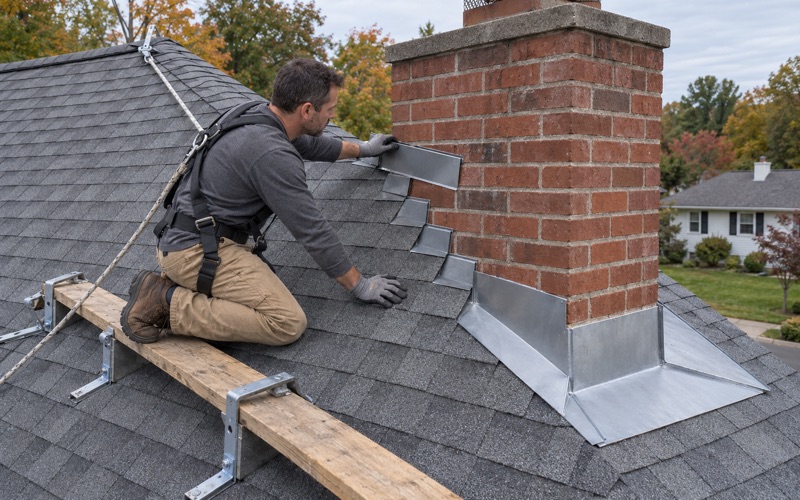
In practice, the chimney is the most complicated few square feet on a re-roof. Shingles, underlayment and flashing all have to tie into masonry that may be decades older than the furnace it serves, and the condition of that masonry decides how well any new flashing will hold over the coming years.
A crumbling mortar joint will not grip counter flashing, and a crown that sheds water into the brick will keep a ceiling wet no matter how carefully the shingles are laid. Those are conditions we point out in writing, with photographs, so you can decide what to fix while the roof is already open.
Looking for roofing closer to Red Bank? See Roofing Services in Red Bank.
What the Chimney Verification Form Asks
The Form the Building Department Posts
The Building Department of the Borough of New Providence, in Union County, works out of 360 Elkwood Avenue and posts a document labeled Chimney Certification among its permit forms. It is the state’s UCC F370, Chimney Verification for Replacement of Fuel-Fired Equipment, a New Jersey form rather than a borough ordinance, and it applies when heating equipment is replaced or converted.
The form lists the replacement types it covers: oil to gas, gas to oil, one gas appliance swapped for another, and oil to oil. For minor and emergency work it goes in with the permit application; for other work it is presented to the code official before final inspection. A homeowner cannot submit it in place of the required inspection.
What an Oil-to-Gas Conversion Has to Show
For a conversion from oil or coal to gas, whoever signs the form states that the chimney or vent is in good repair and clear of obstruction, substantially clean of residue from its previous use, and appropriately lined and sized for the new appliance. Every one of those statements concerns the inside of the chimney, not the roof surrounding it.
With so few oil burners left in the borough, a full conversion is now the rarer case, but the form still covers a gas appliance replacement. If your furnace contractor is working through it while your roof is on our calendar, it helps to know what they are checking, because a liner job and a flashing job may need the same few days of access to the chimney top.
What the Form Is Not
The F370 belongs to fuel-fired equipment work. It is not a roofing document, and replacing shingles around a chimney does not bring it into play. We do not install liners, sign the verification or do any gas or heating work; that stays with your heating contractor and the borough’s inspectors.
What each of our estimates does say plainly is whether the roofing job itself is permit work under the state construction code. Where a furnace swap is happening around the same time, we note it on the scope so nobody assumes one trade’s paperwork covers the other trade’s work, and so the inspection schedule does not catch either crew by surprise.
Lined, Unlined and Oversized Flues
Tile-Lined and Unlined Masonry
The form sorts existing chimneys into types, and two of them are masonry: tile-lined and unlined. It also asks whether the chimney runs inside or outside the house and how tall it is. Those details matter most to the contractor sizing a vent, but the location question matters on the roof too.
An exterior chimney climbs the outside wall and usually meets the roof at an eave or a rake edge, while an interior chimney punches through the middle of a slope. That position changes how water reaches the back of the masonry, whether a cricket is needed behind it, and how the step and counter flashing are laid out on each side.
Why Sizing Comes Up After a Conversion
A flue built for an oil burner can be larger than a modern gas furnace needs. Exhaust that moves slowly through an oversized, cold flue cools before it gets out, and gas exhaust carries water vapor, which is why the question of whether a chimney is appropriately lined and sized matters on the heating side of the job.
From outside, the symptoms can look like a roofing failure: damp brick, white efflorescence, a stained ceiling beside the chimney with no visible gap in the flashing. That is exactly when checking the attic before pricing anything saves money, because new flashing will not stop moisture that starts inside the flue.
Liners and the Borough Fee Schedule
When a liner goes in, the form requires its documentation to accompany the permit application: manufacturer, model, listing, stainless steel or aluminum, sizes and chimney height. New Providence’s fee chapter lists a chimney liner fee of $53 under the fire subcode, a small line item showing that a liner is its own permitted job.
We keep the liner out of our roofing contract for that reason. If your heating contractor recommends one, we work out the order with them so the liner goes in before the new cap and flashing, not after the roof is finished and someone has to cross fresh shingles with tools to reach the top of the chimney.
Flashing, Crown and Cap: The Chimney’s Roof Side
Step and Counter Flashing Replaced, Not Reused
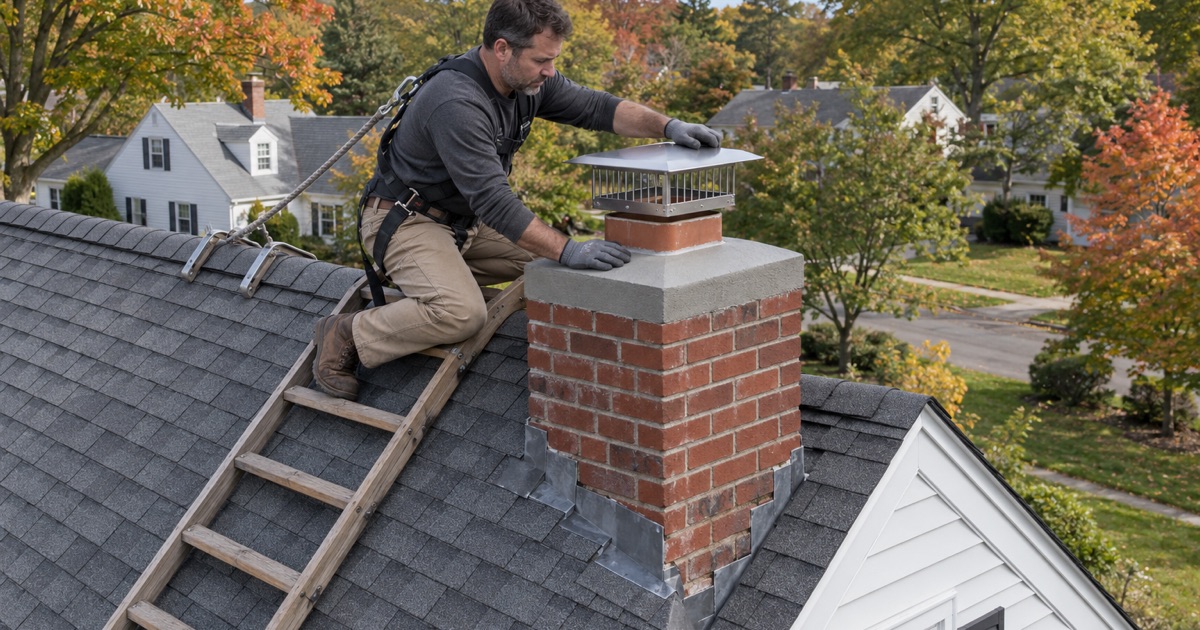
Chimney flashing is two layers working together. Step flashing is woven into each course of shingles along the sides, and counter flashing is set into the mortar joints or a cut reglet and lapped down over it. On every replacement we install new step, counter and chimney flashing rather than bending old metal back over fresh shingles.
Reused flashing is a common reason a new roof leaks at the chimney within a few seasons. Old metal has been bent, nailed and sealed before, and it rarely sits flat against new shingles of a different thickness. Flashing gets its own line on our written scope, separate from tear-off, decking, underlayment, ventilation and gutters, so two estimates can be compared item by item.
Crowns, Caps and Crickets
The crown is the sloped cement top of the masonry, and once it cracks, water runs straight down into the brick. A chimney cap keeps rain, leaves and animals out of the flue. Behind a chimney wider than 30 inches, the residential code calls for a cricket, a small peaked saddle that splits water around the chimney instead of letting it pond against the back.
Crown repair, repointing at the roof line and a new cap are roof-side work we can price in the same scope as the shingles. If a cap has to fit a new liner, though, we wait for the heating contractor’s choice of liner so the two parts are compatible and nobody has to pull a brand-new cap off a week later.
When the Chimney Should Stay Out of the Roof Contract
Some chimney work is not something a re-roof can quietly settle. A liner, a vent connector, or a chimney cut down below the roof line changes how fuel-gas exhaust leaves the house, and that is heating and inspection territory. If a chimney no longer serves anything, taking it down is a decision to make with that in mind, not on the morning of a tear-off.
When we find a chimney that raises those questions, we stop and say so in writing with photographs, then leave room for the right trade before we close up that part of the roof. Rotted decking around the chimney is photographed and shown to you before it is replaced, at the per-sheet price already written into the contract.
Putting the Work in the Right Order
The cleanest sequence is heating work first, then flashing, crown and cap, then shingles. When both jobs land close together, we line up dates with your heating contractor, check attic ventilation as part of the replacement, and clean the driveway, yard and gutters at the end of each day, including a magnet sweep for stray nails.
Our contracts follow New Jersey’s home improvement rules, including the three-day cancellation notice, and every quote treats sales tax the way the state does: taxable on a repair, exempt on a new roof with Form ST-8. If you are selling, we can write a roof condition report for the buyer’s inspector, chimney included.
- 20+ Years on Roofs
- Itemized Written Scopes
- Attic-First Leak Checks