East Brunswick handles roofing in Readington with more than 20 years behind the crew, and a fair share of the township’s older houses wear roofs that deserve a slower conversation than a shingle swap. Before we price anything, we tell you plainly whether the roof can be repaired, and only after that do we talk about replacement.
Every leak visit includes time in the attic as well as on the roof. Water rarely enters where the ceiling stain shows, and on an old roof with a built-in gutter the true entry point can sit several feet from the drip. We trace it first, then write the repair around what we actually found.
Our written scopes break the job into separate lines for tear-off, decking, underlayment, flashing, ventilation and gutters, so you can lay two estimates side by side and compare them item by item. Each estimate also says directly whether the job is permit work under the state construction code, and where a local historic review may apply, we note that on its own line.
Slate and Yankee Gutters Before Readington’s Historic Preservation Commission
Readington Township has run a Historic Preservation Commission since the Township Committee adopted its historic preservation chapter on April 18, 1994. The Commission has seven regular members and up to two alternates, and the chapter lists among its purposes managing change by educating applicants about alterations to historic structures and new construction in historic districts.
Roofs come up at its meetings. The Commission’s agenda for June 14, 2016 lists a review titled Slate Roof – Yankee Gutters for a house in the Three Bridges Historic District. That one line captures the combination we plan around in the township’s older villages: a natural slate field and a gutter built into the roof edge, both sitting in front of a local review body.
Two separate tracks: state code and local review
New Jersey treats the repair or replacement of roof covering on a detached one- or two-family dwelling as ordinary maintenance under the state construction code, so that work does not need a construction permit. That rule says nothing about local historic review, which runs on its own track under the township’s chapter.
We keep the two apart in every estimate. One line answers the construction code question, and another flags whether the house sits in a local historic district, so you know whether time with the Commission belongs in the schedule. Attached homes fall outside the detached-dwelling rule, and 912 of Readington’s homes are one-unit attached, so we check the building type as well.
What we have not read, and will not guess
The chapter’s certificate triggers and any exemption for in-kind roof work were not part of the material we reviewed, and neither were the outcomes of the agenda items. We will not tell you what the Commission requires of your roof, or that your job is exempt. The township answers that question before any work is scheduled.
For construction code questions, the Readington Township Construction Department works from 509 Route 523, Whitehouse Station, under Construction Official Thomas Petto, at (908) 534-2164. Historic review questions go to the Commission itself, and we help you prepare the material it would look at rather than guessing at its answer on your behalf.
Looking for roofing closer to North Arlington? See North Arlington Roofing.
Three Bridges, Readington Village and Centerville: Roofs Under Review
The roof items on the Commission’s 2016 and 2017 agendas are not confined to one hamlet. Three Bridges appears most often, with a new roof in April 2016, the slate and Yankee gutter review that June, and roof replacements in June 2017, one of them for the Three Bridges Reformed Church. Readington Village had roof reviews in September 2016, and Centerville had a replacement listed in June 2017.
Three Bridges
Three Bridges is where the slate review sat, and the agendas show the district drawing roof items year after year. The church on the 2017 agenda is a reminder that review reaches beyond houses: a congregation planning a new roof in a local district faces the same question a homeowner does about what the Commission will want to see.
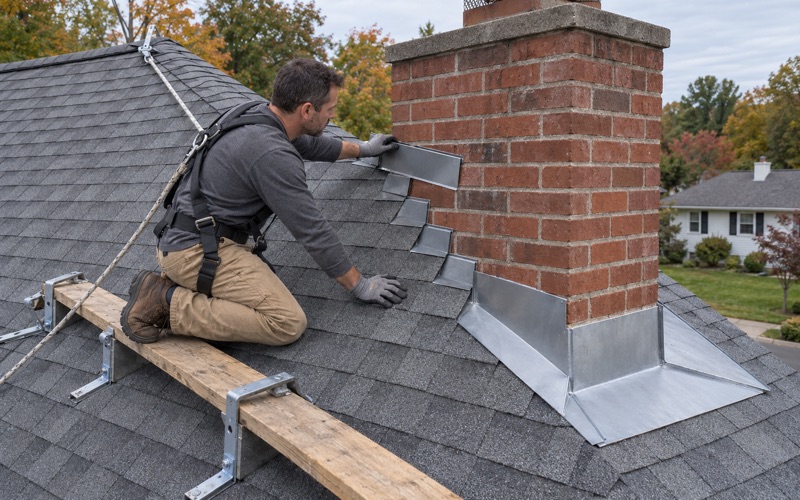
On a building of that age, we look closely at how the roof meets the walls, any tower and every chimney. Step, counter and chimney flashing are replaced along with the roof rather than reused under new material, because old flashing rarely survives a second roof intact and it is usually the first place water finds a way through.
Readington Village and Centerville
Readington Village and Centerville both appear on the agendas with roof work, though the summaries we read do not name a material for either. We never assume slate on a house simply because it is old. We go up, identify what is actually there, and photograph it so you can see the same condition we are describing to you.
A June 2017 agenda also names Stanton, Whitehouse Mechanicsville and Potterstown among the township’s local districts. Which individual properties fall inside any district was not something we read, so confirming that status with the township is one of the first calls we suggest on an older house in any of these villages.
The age of the housing behind it
Census figures for 2024 place 745 of Readington’s 6,491 homes in the group built 1939 or earlier, about 11.5 percent. Those are the houses most likely to carry original materials and built-in gutter details. How many of them have slate has never been counted, and we will not pretend to know.
Most of the township’s housing is newer, with more than half built between 1970 and 1999, so a typical call here is still an asphalt shingle roof. The older village stock is a smaller share of the whole, but it is the share where a wrong first step costs an owner the most.
Repairing Slate in Kind Versus Replacing It
On a slate roof in a Readington historic district, repairing in kind and replacing with something else are two different conversations. The first keeps the roof what it is. The second changes the appearance of a building the township has chosen to review, and it starts with the Commission rather than with a material sample.
Reading the slate before anything is priced
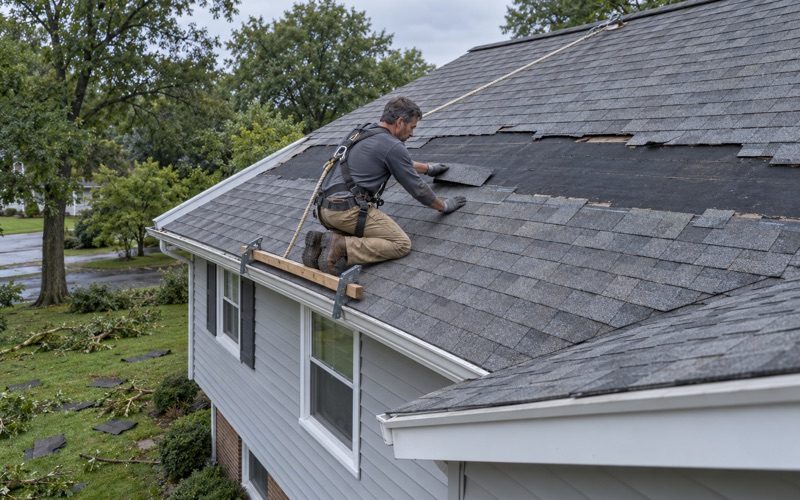
Natural slate often outlasts the nails and flashing holding it, so a roof with broken or slipped pieces may still have a sound field. We check for soft or flaking slates, rusted fasteners and failed valleys before giving an opinion. If the roof can be repaired, you hear that first, and replacement does not come up.
The attic tells part of the story. Staining on the sheathing under a valley or along the eaves points to where water has been getting in, and it often traces back to flashing or a gutter liner rather than the slate itself. We match the stain to the roof above before deciding what work is needed.
What a slate repair involves
Replacing individual slates usually means drawing out the broken piece, matching size, thickness and color as closely as possible, and securing the new slate with a slate hook or a copper strap so no exposed nail is left to rust. Valleys and ridges get copper flashing where copper was used before.
Salvaged or new slate has to be matched with care. A repair that reads as a patch from the street changes how the whole house looks, so we show you samples and photographs of the proposed match before the work goes ahead, and the written scope names the source of the replacement slate.
When replacement is on the table
Some slate roofs are at the end of their life, with delaminating stone across whole slopes, widespread failed fasteners, or decking that has given way. When that is the honest answer, we say so, and we talk through the options without assuming which material the Commission would accept on your house.
The state’s rehabilitation subcode does not allow a new covering to be laid over existing slate, so a replacement means a full tear-off, and the scope prices it that way. Any damaged decking found once the old roof is off is photographed and shown to you before it is replaced, at a per-sheet price already set in the contract.
Yankee Gutters and Bringing a Plan to the Commission
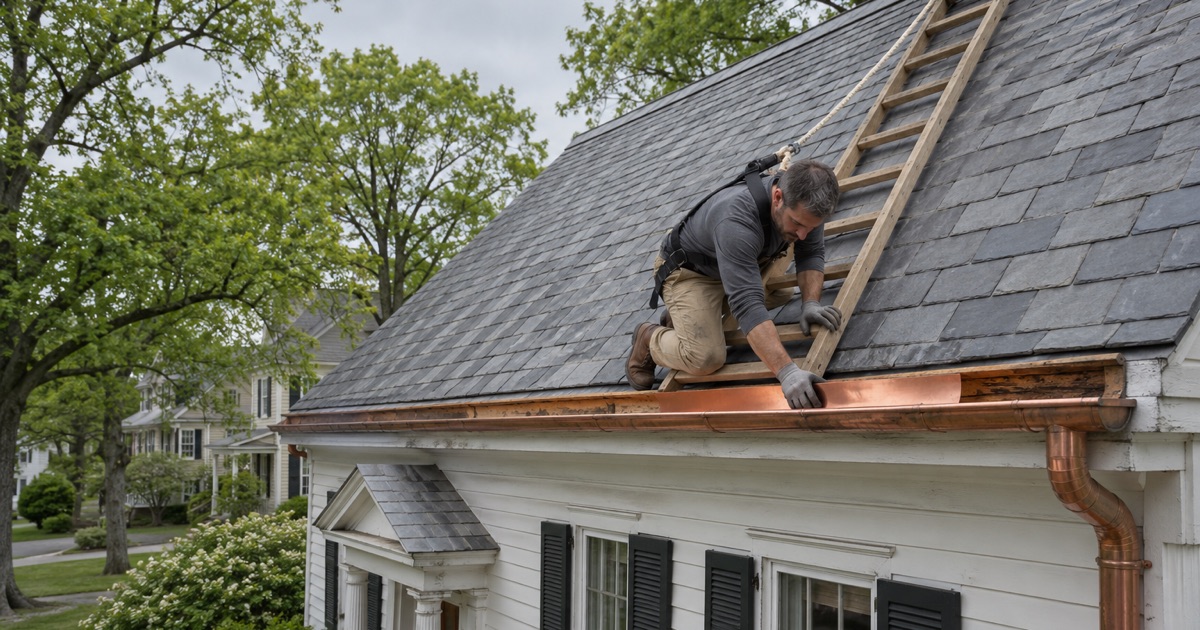
A Yankee gutter is a gutter built into the roof edge itself, usually a wood trough formed into the eave and lined with metal, rather than a gutter hung from the fascia. From the street it reads as part of the cornice, which is exactly why it matters on a historic house and why the 2016 agenda paired it with the slate.
How Yankee gutters fail
Because the trough sits inside the roof line, a split liner or a failed seam sends water into the cornice and wall rather than over the edge. The first sign is often peeling paint or rot on the trim below, or a stain inside an exterior wall. We trace that from the attic and the trough together.
Repairs range from resealing or relining the trough to rebuilding rotted wood beneath it. We size and pitch the gutter and its leaders so water leaves the house rather than pooling at the foundation. Painted trim and fascia on a house built before 1978 are handled under the EPA lead-safe rule for renovation work.
Preparing what the Commission would see
When work may need local review, we put together the material a homeowner can bring: photographs of the existing roof and gutters, a written description of their condition, and a scope naming the proposed materials and details. Clear documentation helps the Commission see what is being kept, what is being repaired and what would change.
We do not speak for the Commission or predict its decision. Our part is giving you an accurate picture of the roof and a scope written plainly enough to present, so the review starts from facts about your house rather than from a general description of slate and built-in gutters.
Storm damage on an older roof
If a storm breaks slate or tears a gutter liner, we photograph the damage and write it up for your own claim, and the crew will meet your insurance adjuster on site if you ask. The claim itself stays yours. Our job is documenting the roof accurately so the record reflects what actually happened to it.
Contracts follow New Jersey’s home improvement rules, including the three-day cancellation notice. A repair quote shows sales tax as taxable, while a new roof can be exempt with Form ST-8, and the estimate spells out which one applies. At the end of each work day, the yard and driveway are cleaned and swept with a magnet for stray nails.
- 20+ Years on Roofs
- Itemized Written Scopes
- Attic-First Leak Checks