
East Brunswick provides roof replacement in East Brunswick, NJ, serving surrounding cities including East Hanover, Highland Park, South Amboy, Metuchen and Aberdeen. For more than 20 years we have replaced roofs on split-levels, colonials, ranches, townhouses and commercial buildings, and nearly every one has started with the same question: does this roof truly need replacing? We answer that honestly before we write a replacement estimate.
When replacement is the right call, the scope we write is itemized. Tear-off, decking, underlayment, flashing, ventilation and gutters appear as separate lines with their own quantities and prices. That makes two estimates comparable item by item, and it shows you exactly what a lower bid has left out.
The job itself is a full system, not just new shingles. Flashing is replaced rather than reused, ventilation is checked and balanced, and damaged decking is shown to you before it is changed. Those details decide whether a new roof lasts its rated life or starts leaking in its first few winters.
Residential and Commercial Roof Replacement
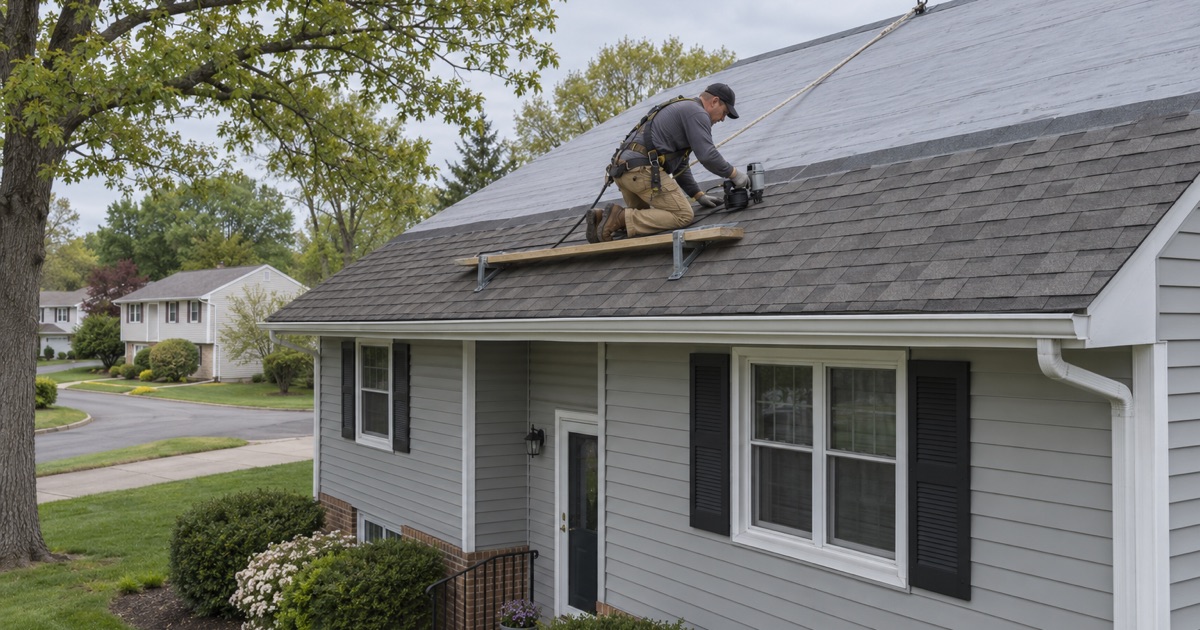
Replacing Roofs on Houses
Most local replacements are asphalt shingle roofs on houses built between the 1950s and the 1980s, many now on their second or third roof. On a detached one- or two-family house, replacing the roof covering is ordinary maintenance under the state construction code, so no permit is required. Your estimate states this plainly, along with how sales tax applies to the job.
Older homes often reveal undersized ventilation, layered roofing and soft spots in the deck once work begins. We plan for those findings in the contract with a per-sheet decking price, rather than pricing them only after the old roof is off. That keeps the final invoice predictable even when the deck turns out worse than expected.
Replacing Commercial and Multifamily Roofs
Commercial buildings, apartment buildings and attached townhouse rows are permit work in New Jersey, and a re-roof there involves the construction office. Low-slope sections typically receive new torch-down modified bitumen, EPDM or TPO membrane, while steep sections get shingles or metal. We coordinate permits, inspections and access with the owner or property manager.
On occupied buildings, scheduling matters as much as materials. We stage work to keep entrances clear, protect tenants and customers from debris and keep each section watertight at the end of every day. Owners receive photographs of the deck and each completed stage for their records.
The Parts of a New Roof System
Underlayment and Ice Barrier
Beneath the shingles, the deck is covered with ASTM D8257 synthetic underlayment, which resists tearing and lies flatter than old felt paper. Along the eaves, in valleys and around penetrations, we install ASTM D1970 self-adhering ice and water barrier. Middlesex County is outside New Jersey’s mandatory ice-barrier area, but eaves here still see ice dams in hard winters.
The underlayment is the roof’s second line of defense. When wind lifts a shingle or ice backs water up under a course, the membrane beneath keeps that water out of the house. Cutting corners there saves little money and removes most of the roof’s margin for error.
Shingles and Their Ratings
We install architectural shingles such as GAF Timberline HDZ, Owens Corning Duration and CertainTeed Landmark. Each carries an ASTM E108 or UL 790 Class A fire rating, and wind ratings such as ASTM D3161 Class F and ASTM D7158 Class H describe how well the shingles resist uplift. Impact-rated lines with UL 2218 Class 4 ratings are available for homeowners who want them.
Color is chosen with full-size samples held against your siding and brick. A blend that suits a gray-sided split-level may look wrong on a red brick colonial, so we suggest viewing samples outside at different times of day. The shingle line also affects which warranty terms apply.
Flashing Made New
Step flashing along walls, counter flashing at chimneys, apron flashing at the base of walls and kick-out flashing at roof edges are all replaced with the roof. Reusing old flashing under new shingles is a common shortcut, and it is a common reason new roofs leak. Chimneys wider than 30 inches also get a cricket so water is directed around them.
Pipe boots are replaced at every plumbing vent, and drip edge is installed along all eaves and rakes. These are small parts with a large effect on whether water stays outside, and each appears as its own item in our scope.
Ventilation That Lets the Roof Breathe
We check attic ventilation on every replacement, measuring intake at the soffits against exhaust at the ridge by net free area. Many older houses have soffit vents buried under insulation, or a few small roof vents doing the work of a full ridge vent. Correcting the balance during replacement costs far less than doing it later.
Poor ventilation shortens shingle life from underneath, cooking the roof in summer and feeding condensation in winter. A properly vented attic also helps prevent ice dams and keeps the warranty conditions that many manufacturers place on ventilation.
How a Replacement Runs
Before the First Shingle Comes Off
We confirm the shingle color and line, the start date, dumpster placement and any special coordination such as solar panel removal. Landscaping, air conditioning units and walkways are covered with tarps, and plywood protects the driveway under the dumpster. Neighbors on shared walls are told when work will begin on attached homes.
Tear-Off and Deck Inspection
The old roofing is stripped to the deck and every sheet is inspected once exposed. Damaged or rotted decking is photographed and shown to you before replacement, at the per-sheet price written into the contract. Nails are re-set, protruding fasteners are removed and the deck is swept clean before any new material goes down.
If we find more than two layers or hidden problems such as old slate under shingles, we stop and explain before going further. Those surprises are rare when layers are counted during the estimate, which is why we check at the eaves and in the attic before quoting.
Installation and Daily Cleanup
Drip edge, ice barrier, underlayment, flashing, vents and shingles go on in sequence, with each section made watertight before the crew leaves for the day. Most houses are finished within one to three working days. Weather may delay a start, and we would rather wait than open a roof ahead of rain.
At the end of each day the driveway, yard and gutters are cleaned and a magnet sweep picks up stray roofing nails. That matters for families, pets and anyone parking in the driveway overnight. A final walk-through with you closes the job.
Situations That Need Extra Planning
Roofs Under Solar Panels
When panels are on the roof, their removal and reinstallation have to be part of the schedule from the start. We coordinate with your solar installer so panels come off before tear-off and return to new flashing at every mount. Leaving that to the last minute is how projects stall and panel warranties get complicated.
Townhouses and Association Roofs
In townhouse, condominium and 55+ communities, the roof may belong to the association rather than the owner. We check the governing documents before writing an estimate, because only the right party can authorize the work. Where a single unit is replaced, the new roof has to tie cleanly into the neighbors’ roof at the shared ridge and party wall.
Homes in Flood Hazard Areas
Parts of the township, including the Old Bridge section near the South River, lie in mapped flood hazard areas. In those areas, roofing counts toward the federal substantial improvement calculation even without a construction permit. We raise this early when a replacement is part of a larger renovation, so owners can check with the floodplain manager first.
- 20+ Years on Roofs
- Itemized Written Scopes
- Attic-First Leak Checks