East Brunswick brings more than 20 years of work to roofing in Roselle Park, and on the borough’s older houses the first question is rarely which shingle to buy. It is what the existing covering is made of. Asphalt, wood and asbestos-cement can all sit on a roof that went on generations ago, and the answer decides who takes it off, how it leaves the property and how long the job runs.
When a call starts with a leak, we look in the attic as well as on the roof, so the water is traced to the spot where it actually gets in before a price is written. You get a straight answer on whether the roof can be repaired, and replacement only comes up when a repair would not hold. On an older house that answer matters more than usual, because a sound repair can leave an untested covering undisturbed.
When replacement is the right call, our written scope breaks the job into separate lines for tear-off, decking, underlayment, flashing, ventilation and gutters. On an older house it carries one more line ahead of those: how the existing material will be identified, and what happens to the schedule if the result comes back positive. Two estimates written that way can be compared item by item.
Roselle Park’s 1940s Houses and Asbestos-Cement Roofing
How old the housing stock is
The American Community Survey’s 2024 five-year estimates date 1,547 of Roselle Park’s 5,522 housing units to 1939 or earlier and another 1,050 to the 1940s. That puts 47.0 percent of the borough’s homes before 1950, with a median year built of 1952. The count for 2000 through 2009 is zero, so very little of the stock is recent.
Those decades overlap the years when asbestos-cement siding and roof shingles were common building products. The New Jersey Department of Health lists roof shingles among the products that may contain asbestos, and says asbestos-containing siding was commonly used as a building material. Build era tells us where to be careful. It does not tell us what any one roof is made of.
What asbestos-cement roofing looks like
Asbestos-cement shingles, sometimes called by the old trade name transite, are rigid and brittle compared with asphalt. They were often laid as squares or diamonds with a slightly textured face, and they tend to crack rather than bend when a flat bar goes under them. Siding of the same material usually shows up as long, flat panels with a stippled or grained surface.
Appearance is a reason to ask, not an answer. Fiber-cement products made later can look much the same, and the Department of Health’s list names roof shingles generally rather than one style. We do not guess from the ground or from a photo, and we will not tell an owner that a covering is clear, or that it is not, until a sample has been tested.
What the survey numbers cannot tell you
No source we have counts how many Roselle Park houses carry asbestos-cement roofing or siding, and house styles here have never been surveyed for it. Plenty of older houses have been reroofed several times, and the original covering may be long gone. Others still carry siding from the year they were built, sometimes under a later layer of vinyl or aluminum.
That uncertainty is the reason the test belongs at the start of the job. Finding out after the crew has pulled up half a slope means stopping work with a roof open to the weather. A material that has been broken and scattered across a deck is also far harder to deal with than one that was identified while it was still intact.
Looking for roofing closer to New Providence? See Roofing in New Providence.
Testing an Old Covering Before the Tear-Off
Planning the test into the estimate
On a pre-1950 house where the existing roof or siding looks like a cement product, we say so in the written estimate and treat the test as the first step of the job. A small sample of the material in question goes to a laboratory for analysis. The estimate then shows what follows from each possible result rather than assuming one.
If the lab test comes back negative, the tear-off proceeds as an ordinary roof replacement. If it comes back positive, the plan changes before anything is pried loose: who removes the material, how it leaves the property, and how many days the house goes without its old roof. Owners get that decision on paper while there is still time to weigh it.
Which layers need checking
Older roofs often carry more than one layer, and the bottom layer is the one most likely to date from the original construction. A sample from the top shingle says nothing about what sits underneath it. Where a lower course shows at an edge, a vent or a valley, the sample covers every distinct material, not just the visible one.
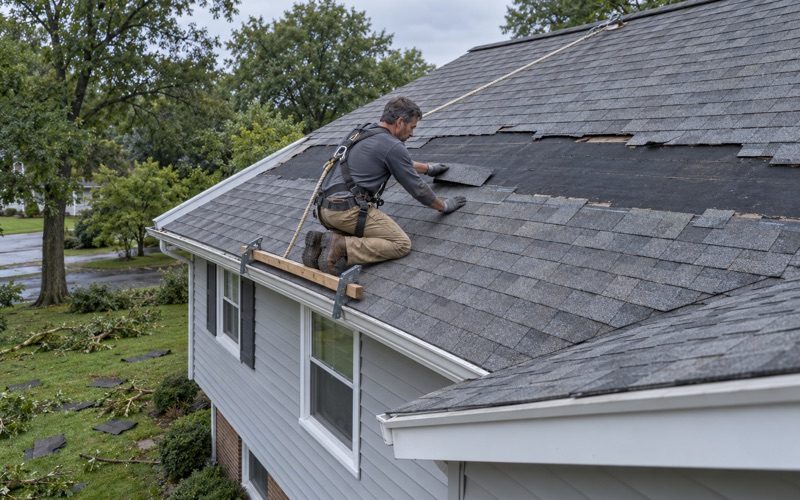
Layer count matters for another reason. The state’s rehabilitation subcode calls for a tear-off when a roof already has two or more layers, so a house that took an overlay years ago may now need everything removed. On an older borough house that can put an untested bottom layer squarely in the path of the work.
Whether the job is permit work
Every estimate says plainly whether the job is permit work under the state construction code. Replacing the roof covering on a detached one- or two-family house is ordinary maintenance under NJAC 5:23-2.7, which needs no permit, inspection or notice. The borough’s Construction Code Department reproduces that rule in its own Ordinary Maintenance handout for homeowners.
The same handout excludes the removal or cutting of any structural beam or bearing support, and any work affecting structural or fire safety. If the tear-off turns up rotted rafters that have to be cut out, that part of the job is no longer ordinary maintenance. Attached houses and larger buildings fall outside the roof-covering wording too, and we tell owners so up front.
Licenses, Removal and Disposal Under State Rules
The Department of Labor license
According to the Department of Health, New Jersey requires every contractor who abates asbestos-containing materials to hold a license from the state Department of Labor and Workforce Development. Workers on an abatement crew hold Department of Labor worker or supervisor permits as well. These are statewide rules rather than a Roselle Park ordinance, and they apply the same way across Union County.
We are a roofing company, and we hold no asbestos license of any kind. When a test comes back positive on a roof covering, the removal is planned around a contractor who carries that Department of Labor license. Our crew comes in once the material is gone to handle the decking, underlayment, flashing and new roof.
The siding exception, and where it stops
The Department of Health states one exception. For asbestos siding, it says removal does not have to be done by an asbestos contractor holding a New Jersey license, unless the building is to be demolished. That sentence is written about siding. The department gives no separate rule for asbestos-cement roof shingles, and we do not stretch the siding wording to cover a roof.
In practice the roof is planned on the stricter footing. If an owner has heard that cement shingles can come off like any other roof, that advice does not come from the state health department. We would rather budget a licensed abatement step that turns out to be routine than discover halfway through a tear-off that one was needed.
Removal by the owner
The Department of Health strongly advises homeowners against removing asbestos from their own houses. Breaking, scraping or prying cement shingles can release fibers, and the person doing the prying is the one standing closest to them. We will not schedule a tear-off around owner removal of a covering that tested positive, and we point anyone weighing it toward the department’s guidance first.
Disposal goes through a regulated route
Old asphalt shingles go into the roll-off container with the rest of an ordinary tear-off. Asbestos-containing waste does not follow that path. The Department of Health says the transportation and disposal of asbestos-containing waste in New Jersey is regulated by the Department of Environmental Protection, so that material leaves the property on a route NJDEP oversees rather than mixed into roofing debris.
We do not quote a disposal site or a disposal fee for asbestos waste, because that belongs to the abatement contractor working under the state’s rules. What our estimate shows is the separation: the abatement step, our tear-off line for any remaining layers that tested clean, and a clear point where one crew’s work ends and the other’s begins.
Covering Over, Removing, or Leaving Asbestos Siding in Place
Siding that can stay
The Department of Health says there is no state requirement that asbestos siding be removed before new siding is installed. The borough’s Ordinary Maintenance handout treats siding on one- and two-family dwellings as ordinary maintenance, with polypropylene siding the stated exception. For many owners, leaving intact cement siding undisturbed under a new layer is the simpler path.
Where the siding meets the roof, though, the two jobs touch. Step flashing along a sidewall and kick-out flashing at the eave tuck behind the wall cladding, and on a cement-sided wall that can mean cutting or lifting the very material that was tested. We plan those joints before work starts rather than finding them on the day.
Flashing replaced, not reused
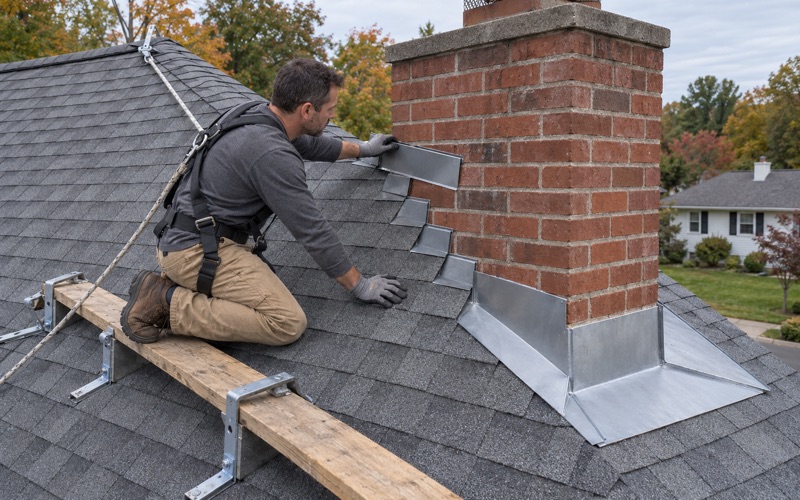
Step, counter and chimney flashing is replaced with the roof on every job rather than reused under new shingles. On a 1940s house the chimney is often the oldest detail on the roof, and the old counter flashing may be set into mortar joints or a reglet that needs repointing. That work stays inside our scope once any abatement step is finished.
Decking and ventilation under an older roof
Once the old covering is off, damaged decking is photographed and shown to the owner before a single sheet is replaced, at a per-sheet price already written into the contract. Older houses often have plank sheathing rather than plywood, and the condition of those boards stays hidden until the roof is open.
We also check attic ventilation on every replacement, because a roof that cannot breathe ages from underneath. An older attic may have little intake at the eaves, so pairing a ridge vent with soffit intake is usually part of the conversation. Gutters and leaders are sized and pitched with the new roof, so water leaves the house instead of collecting at the foundation.
Contracts, sales tax and cleanup
Our contracts follow New Jersey’s home improvement rules, including the three-day cancellation notice. A new roof is a capital improvement exempt from sales tax with Form ST-8, while a repair is taxable, and each quote states it that way. Every work day ends with the driveway, yard and gutters cleaned and a magnet sweep for roofing nails.
Questions about whether a particular job counts as permit work belong with the borough’s Construction Code Department at 110 East Westfield Avenue, which posts its handouts for homeowners. We put our own answer in writing on the estimate, so the first time an owner hears it is not from an inspector standing in the driveway.
- 20+ Years on Roofs
- Itemized Written Scopes
- Attic-First Leak Checks