East Brunswick has handled roofing in South Amboy for more than 20 years, and the part of a roof job most owners never think about is where the water and the debris go once they leave the roof. Every shingle sheds rain to a gutter, every gutter empties through a leader, and in this city that water joins a storm drain system the city answers for under its own state permit. We plan roofs here with that whole path in mind.
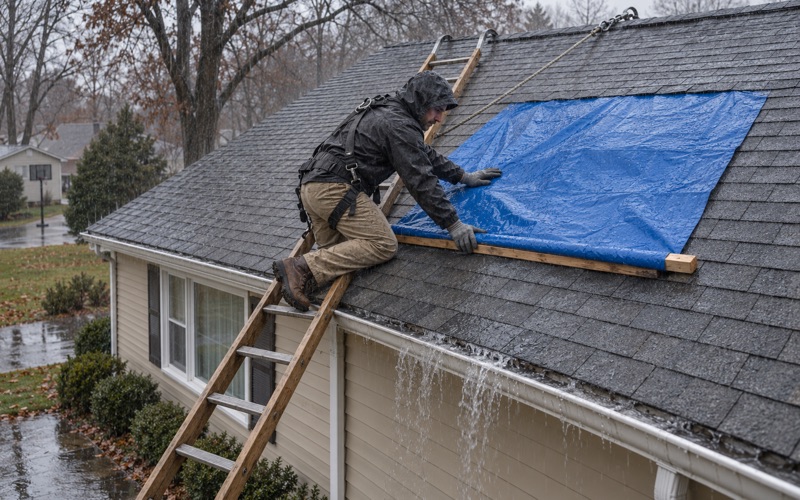
Our work starts the same way on every leak call: we look in the attic as well as on the roof, so the water is traced to the spot where it actually enters before anyone prices a fix. If the roof can be repaired, we say so plainly before replacement comes up at all. When replacement is the honest answer, the written scope breaks out tear-off, decking, underlayment, flashing, ventilation and gutters as separate lines you can compare against any other bid.
This page covers what a South Amboy owner should know about stormwater and roofing: the ordinances the city enforces, how downspouts and rain barrels fit in, what happens to tear-off granules and nails during a job, and why a re-roof sits outside the rules written for new development. None of it decides whether your roof needs work. It decides how a careful crew does that work on your street.
South Amboy’s Stormwater Permit and Where Roof Water Goes

A Permit Number Behind the Storm Sewer
South Amboy runs its municipal stormwater program under a New Jersey Pollutant Discharge Elimination System permit, number NJG0152366. The city keeps a Stormwater Pollution Prevention Plan to go with it, first adopted in February 2005, revised most recently on March 17, 2026, and set for annual review on May 1, 2026. That plan names a Stormwater Program Coordinator, Kenneth Krass, and lists what the city does and what it enforces.
For a homeowner, the practical point is simple. Rain that runs off a roof, down a leader and across a driveway does not vanish; on many lots it reaches the curb and a street inlet within minutes. The city has committed in writing to the state to keep that system as clean as it can, which is why what comes off a roof during a job matters in a city built along Raritan Bay.
Monthly Street Sweeping and Public Outreach
The plan states that all roadways in the City of South Amboy are swept every month. It also counted a Green Infrastructure Workshop and a Rain Barrel Workshop toward its public education points, and the stormwater program set up a display with promotional items at National Night Out on August 5, 2025.
A monthly sweep is a good routine, but it is not a cleanup service for a job site. Granules and nails left in the gutter line at the curb can wash into an inlet with the next storm, weeks before the sweeper comes back around. We treat the street in front of a house as part of the job for exactly that reason.
Looking for roofing closer to Metuchen? See Roofing in Metuchen.
The Model Ordinances on the City’s Books, and Their Fines
South Amboy adopted New Jersey’s model stormwater ordinances without changing them, and its plan lists each one with an adoption date and a fine. The police department and code enforcement enforce them. Several have nothing to do with roofs, but a few describe exactly the kind of mess a careless tear-off can leave behind.
Improper Disposal of Waste and Litter Control
The improper disposal of waste ordinance, adopted December 20, 2006, carries a $1,000 fine. Litter control, adopted the same day, carries a $500 fine. Neither names roofing, and we found no record of either one being used against a roofer in South Amboy.
Still, shingle scraps, wrapper film and loose nails in the street are the kind of material those ordinances were written to keep out of the storm drain. Whether an officer would cite roofing debris under one of them is a question nobody has answered on the record. We would rather that question never come up on a property we worked on.
Illicit Connections, Read Correctly
The illicit connections ordinance, adopted December 1, 2006, carries a $500 fine, and it is the one homeowners most often misread. The state model it copies is aimed at sewage and process water piped into the storm sewer. It is not a rule about roof leaders, and nothing in the city’s plan that we read speaks to where a downspout discharges.
We raise it because owners sometimes hear the phrase and assume a gutter project needs special clearance from the city. Nothing we read points that way. What does matter is that each leader we install sends roof water somewhere sensible, which is a drainage question for your lot rather than a legal one.
The Rest of the List
The plan also lists private storm drain inlet retrofitting, adopted September 1, 2010, with a $500 fine; yard waste at $250; and tree removal and replacement, adopted May 15, 2024, at $2,000. Pet waste, wildlife feeding and privately owned salt storage round it out, and the plan says the city has no stormwater ordinances beyond these.
The tree ordinance is the one a roofing customer is most likely to brush against, since an overhanging limb often gets dealt with before a new roof goes on. That work and its paperwork belong to the owner and the tree company. We simply plan the roofing schedule around it so the two jobs do not collide.
Downspouts, Leaders and Rain Barrels
Where the Leaders Discharge
A roof sheds every drop of rain that lands on it, and the leaders decide where that water ends up. Discharge too close to a foundation and it soaks the soil against the basement wall. Discharge across a walk and it freezes into a sheet of ice in January.
Leaders get cut short, crushed by a mower or left unextended after a porch goes on, and the problem rarely shows until the basement is wet. Part of every gutter scope we write is where each leader ends and what the water crosses on its way out, so the discharge point is a decision rather than something inherited from the last owner.
Gutters Sized and Pitched With the Roof
We size and pitch gutters and leaders together with the roof rather than treating them as an add-on. Seamless aluminum gutters and leaders are what we quote on most homes, and the drip edge at the eaves has to sit correctly over the gutter so water reaches it in the first place.
A gutter that holds standing water, or a leader too small for the roof area feeding it, overflows at the corners and dumps water exactly where the foundation least wants it. Getting the pitch and the number of outlets right costs far less during a replacement than it does as a separate trip afterward.
Rain Barrels on a Roof Leader
The city’s Rain Barrel Workshop reflects real interest in catching roof water rather than sending all of it to the street. Nothing in the plan makes a rain barrel mandatory, and each owner decides whether one suits the lot. If you want one, the leader feeding it has to be cut and fitted for it, and the barrel needs an overflow that carries water away from the house.
We can set a leader up for a barrel when we install new gutters, or leave a clean connection point so one can be added later. A barrel fills fast in a heavy storm, so the overflow path matters more than the barrel itself. The idea behind the city’s green infrastructure outreach holds here too: keep water on the property where it can soak in, but never against the foundation.
Tear-Off Debris, Street Inlets and the Major Development Line
Keeping Granules and Nails Out of Street Inlets
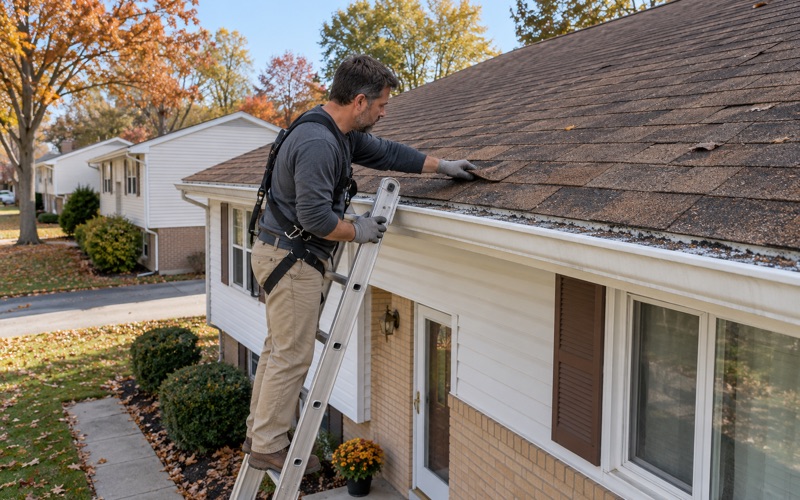
A tear-off produces loose granules, broken shingle pieces, old underlayment and hundreds of roofing nails. On a tight lot, the nearest storm drain inlet may sit only a few steps from the end of the driveway, and loose granules travel downhill with the first rain.
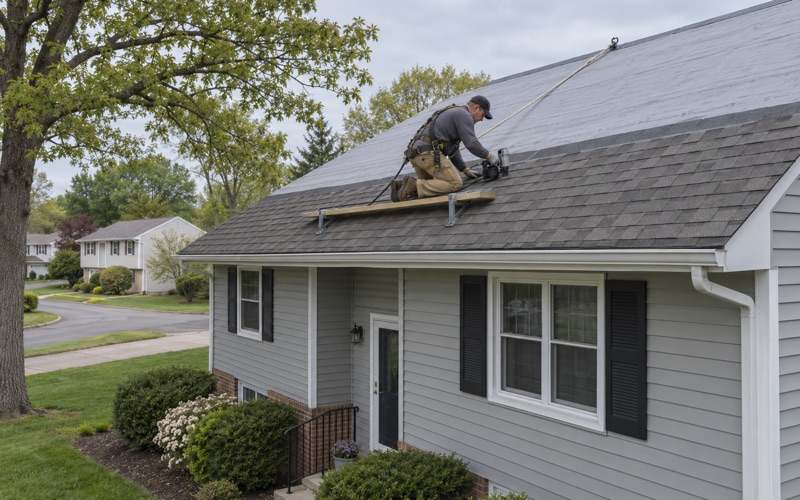
We stage the work so debris goes from the roof straight into a container rather than onto the lawn or the drive. Tarps catch what falls, the area around any nearby inlet is kept clear, and nothing gets swept toward the curb to be dealt with later.
Daily Cleanup and the Magnetic Nail Sweep
At the end of every work day the crew cleans the driveway, the yard and the gutters, finishing with a magnetic nail sweep across the lawn, the drive and the street edge. A nail in a tire is the obvious hazard. A nail rusting in a street inlet is the one nobody sees, and it is the reason the street edge gets swept along with everything else.
Gutters get their own attention on the last day. Tear-off debris that lands in an open gutter will flush straight to the leader outlets in the first storm, and new shingles shed some loose granules early on. Clearing the gutters before we leave keeps that first runoff as clean as we can make it.
Why a Re-Roof Is Not Major Development
South Amboy’s stormwater control ordinance is the same as the state model. It was adopted September 1, 2010, revised February 17 and May 5, 2021, and it reaches major development, which the plan defines as disturbing one or more acres of land or adding a quarter acre of new impervious coverage.
A re-roof replaces a covering that is already there. It adds no new impervious surface and disturbs no ground, so by that definition the stormwater control ordinance does not reach it. The rules that do bear on a re-roof are the everyday ones: where the leaders send water and what ends up in the street.
What the Written Scope Shows
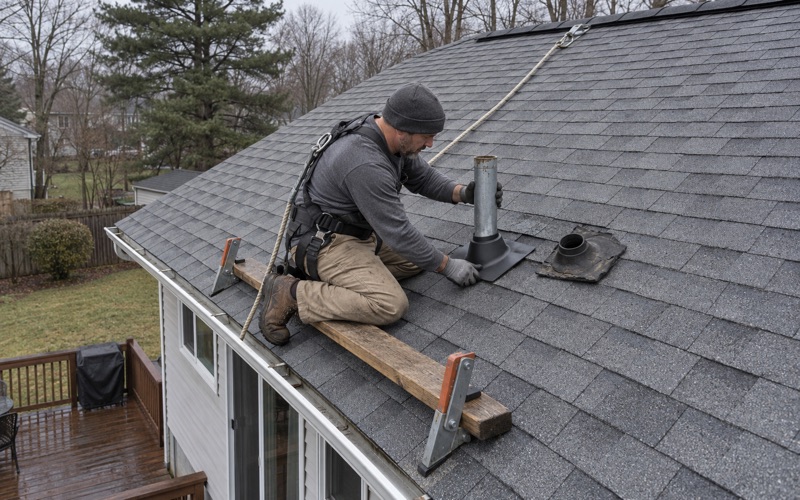
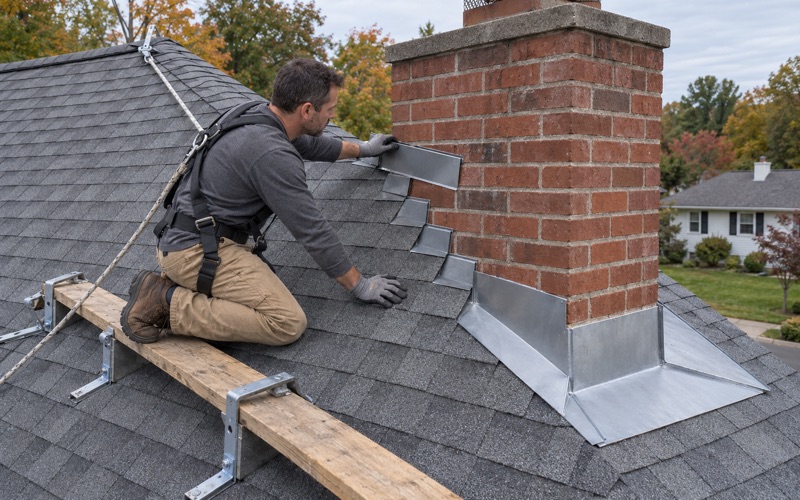
When decking turns out to be damaged once the old roof is off, we photograph it and show you before replacing it, at a per-sheet price already set in the contract. Step, counter and chimney flashing is replaced with the roof instead of reused, and attic ventilation is checked on every replacement because a roof that cannot breathe ages from underneath.
Every estimate says plainly whether the job is permit work under the state construction code. Contracts follow New Jersey’s home improvement rules, including the three-day cancellation notice, and quotes state sales tax the way the state treats each job: taxable on a repair, exempt on a new roof with Form ST-8.
- 20+ Years on Roofs
- Itemized Written Scopes
- Attic-First Leak Checks