East Brunswick has handled roofing in Springfield Township for more than 20 years, and the work we are asked about most after a hard winter is the work nobody can see from the driveway. A roof that carried a deep snowpack for days can look the same in spring as it did in fall, while the shingles near the eaves, the flashing and the decking underneath tell a different story.
Our approach starts with finding the actual problem before talking about price. When water shows up on a ceiling, we go into the attic as well as onto the roof, so the stain is traced back to the place where water really gets in. Then we tell you plainly whether a repair will do the job, and only after that do we discuss replacement.
This page covers what a heavy snow does to a roof here: how much that snow can weigh, why meltwater backs up at the gutter line, what damage tends to appear only after the melt, and how we inspect an older roof once a big storm has passed. It is written for owners who want to know what to look for and what to ask.
The February 2026 Blizzard and What It Weighed
What the Snowfall Reports Recorded
Springfield’s most recent big snow is on the record rather than in memory. In the blizzard of February 22-23, 2026, National Weather Service snowfall reports republished by WABC-TV put Springfield at 19.3 inches, with a second reporting point just south-southeast of town at 17.0 inches. Either number is a lot of snow to leave sitting on a residential roof.
The state took the storm seriously before it arrived. New Jersey’s state of emergency took effect at noon on Sunday, February 22, covering all 21 counties, and the National Weather Service office in Upton later confirmed that blizzard criteria were met on February 23 in Eastern Union County. For a roof, though, the label matters less than the depth of snow resting on it.
Turning Inches Into Pounds
Snow load is the term for that weight, and it varies more than most owners expect. FEMA, as quoted by Fox Weather, puts a foot of fresh snow at about 3 pounds per square foot when it is light and dry and about 21 pounds per square foot when it is wet and heavy. Packed snow weighs more, though the quoted figures give no number for it.
Scaling that range to 19 inches gives roughly 5 to 34 pounds on each square foot of roof, depending on how wet the snow was. That is arithmetic on FEMA’s figures, not a measurement taken on any Springfield roof, and it is why we never quote one number for the storm. Two houses on the same street could have carried very different loads.
Why the Eaves Take the Worst of It
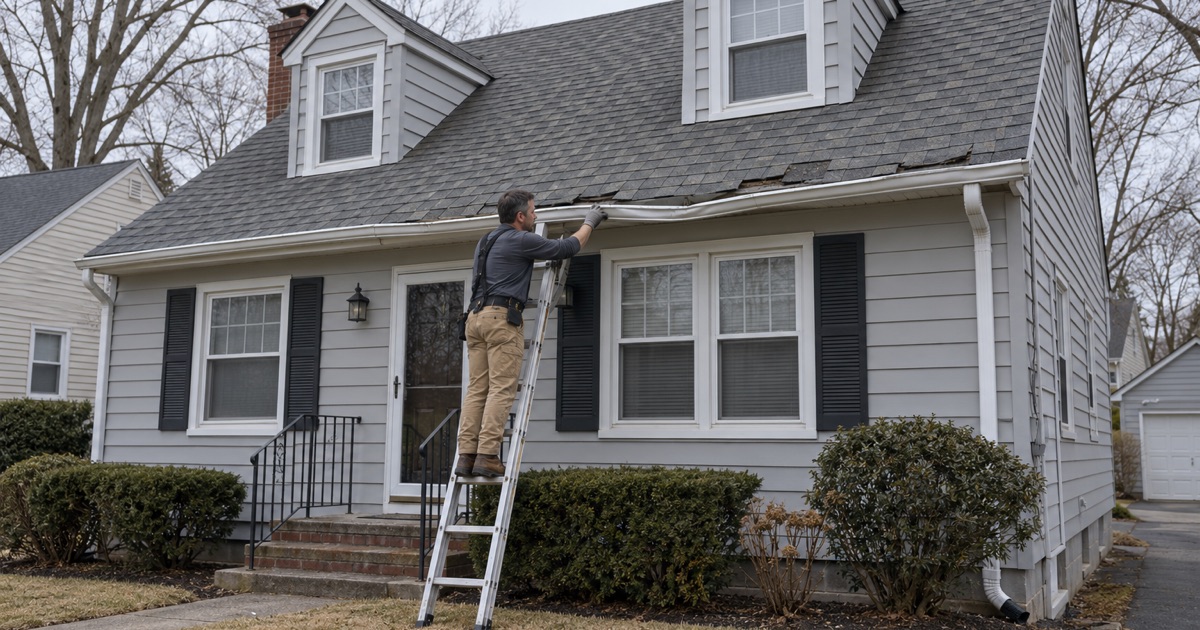
Weight is not spread evenly across a roof. Snow slides and drifts toward the lower edges, and the eaves, which overhang the exterior walls and sit over unheated soffits, are where the load and the cold meet. That overhang is also where the shingles, drip edge and gutters are fastened, so it is the first place we look after a deep snow.
We never put a number on the weight a particular roof will carry, because that depends on framing, spans, sheathing and condition we have not yet seen. What we can do is look for signs that a roof has been working hard: a sagging line along the ridge, cracked rafters or sheathing seen from the attic, and fasteners that have backed out near the edges.
Looking for roofing closer to Tinton Falls? See Roofing in Tinton Falls.
Ice Dams and Leaks at the Gutter Line
How an Ice Dam Forms
An ice dam starts with heat. Warmth escaping from the living space into the attic melts the underside of the snowpack, and the meltwater runs down the roof until it reaches the cold eave, where it freezes again. Over several days that frozen ridge grows along the gutter line and holds back the water still running down behind it.
Deep snow makes the cycle worse because it insulates the roof surface and supplies meltwater for a long time. A pack near 19 inches can keep feeding an ice dam well after the storm ends, especially through a run of sunny days and freezing nights. The standing water behind the dam then finds its way under shingles that were only ever designed to shed water downhill.
Where the Water Goes
Water backed up behind an ice dam can travel under shingle courses, past the nail line and onto the decking. From there it shows up as a stain on a ceiling near an exterior wall, wet insulation over the eaves, peeling paint on soffits, or a damp patch high on an upstairs wall. By the time it shows indoors, it has usually been running for a while.
When we trace one of these leaks, we start in the attic, because the wet path there tells us more than the stain below it. We check the insulation and the underside of the decking along the eaves, then compare that with what we find on the roof. That keeps us from pricing a repair at the wrong spot.
Ventilation, Underlayment and Gutters
Most ice dams trace back to an attic that is too warm or poorly vented. A ridge vent paired with clear soffit intake keeps the roof deck closer to the outdoor temperature, so less snow melts from below. We check attic ventilation on every replacement, because a roof that cannot breathe ages from underneath and builds ice at its edges each winter.
On a new roof, many owners choose a self-adhering ice and water barrier meeting ASTM D1970 along the eaves as an added layer of protection. It is a material choice we discuss with you, not something we present as a code mandate. We also size and pitch gutters and leaders with the roof, so meltwater actually leaves the house rather than pooling at the foundation.
Damage That Shows Up After the Melt
Shingles and Flashing
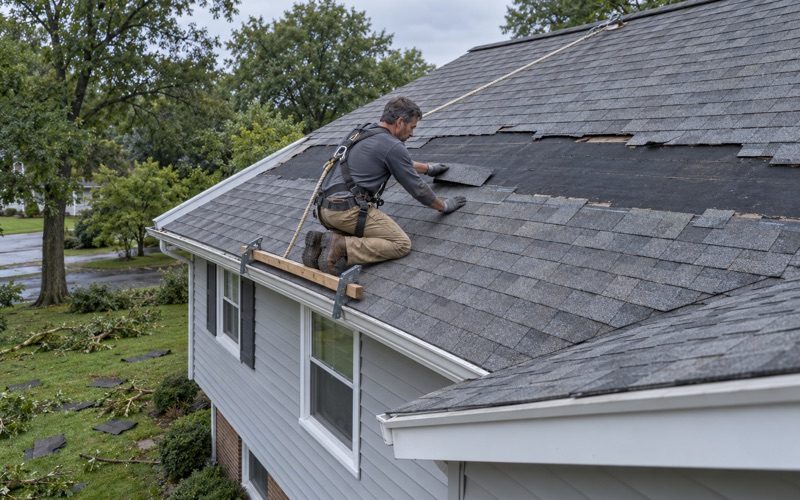
Snow hides a roof. Shingles that cracked in the cold, lifted at the edges when ice formed beneath them, or lost granules where a pack slid off all stay out of sight until the snow is gone. That is why the weeks after a thaw are often a better time for an inspection than the day after a storm.
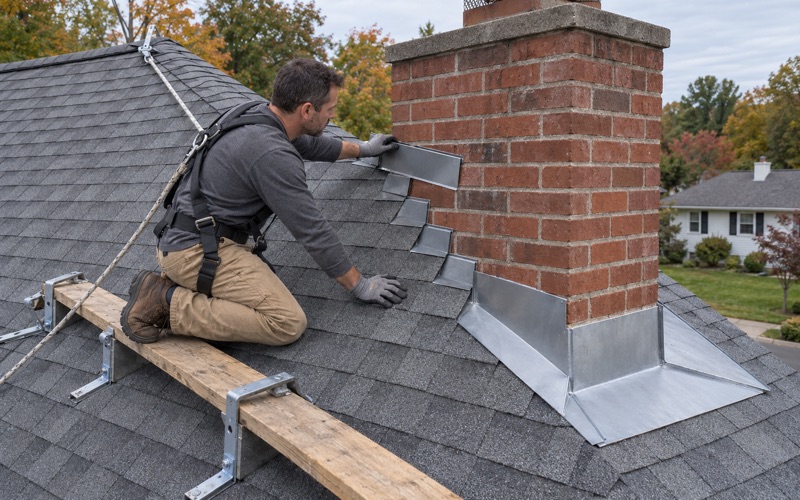
Flashing is the other common casualty. Ice that forms behind a chimney or along a sidewall can work step flashing and counter flashing loose, and a chimney without a cricket can trap snow behind it for days. When we replace a roof, we replace step, counter and chimney flashing with it rather than reusing old metal under new shingles.
Gutters, Drip Edge and Fascia
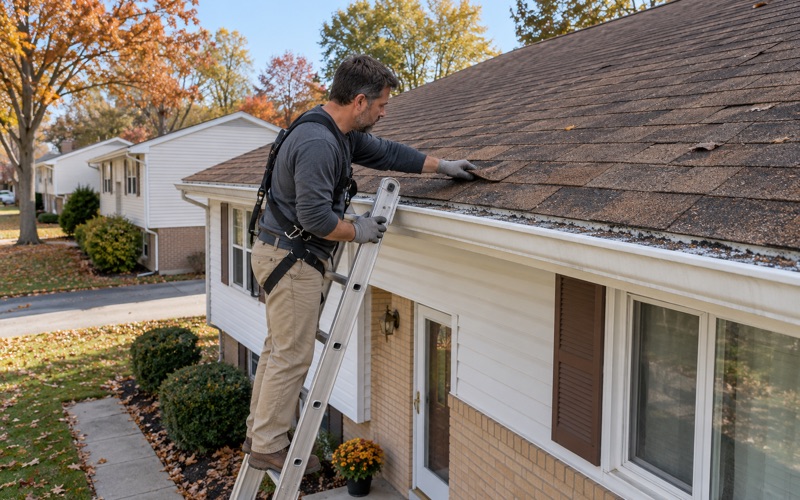
Gutters often carry the most visible damage after a heavy snow. Ice packed into a gutter adds weight the hangers were never meant to bear, and gutters can pull away from the fascia or bend out of pitch. Behind them, the drip edge and fascia board may have taken on water, and on older homes that trim is often painted.
On houses built before 1978, painted fascia and trim can contain lead, so we follow the EPA’s lead-safe work practices whenever that trim is disturbed. At the end of each work day we clean the driveway, yard and gutters, including a magnet sweep for roofing nails, so a repair along the eaves does not leave a hazard behind.
Documenting Storm Damage
If you decide to file a claim with your own insurer, clear records help. We photograph storm damage and write it up so you can include it with your claim, and when you ask, our crew will meet the insurance adjuster on site to show what we found. The claim itself stays between you and your insurer, and coverage depends on your policy.
We also note what we cannot attribute to the storm. Worn shingles and old flashing failures are part of a roof’s age, not snow damage, and a report that blends the two helps nobody. Separating them gives you an honest picture and a sound basis for deciding whether repair or replacement makes sense.
Inspecting a 1950s or 1960s Roof After a Big Storm
Why Build Era Matters Here
Springfield, a township of 17,178 people at the 2020 census, sits on a ridge at the foot of the Watchung Mountains. Much of its housing went up in a single burst: the population roughly doubled between the 1950 and 1960 censuses, from 7,214 to 14,467. Recent Census estimates count 2,058 units built from 1950 to 1959 and 1,522 more from 1960 to 1969.
Together those two decades account for 49.2% of the township’s 7,277 housing units. A house that old may have been re-roofed more than once, yet the framing underneath is usually the structure it was built with. Heavy snow puts that original structure to work in a way an ordinary rain never does, which is why we look at it from the attic.
What We Check
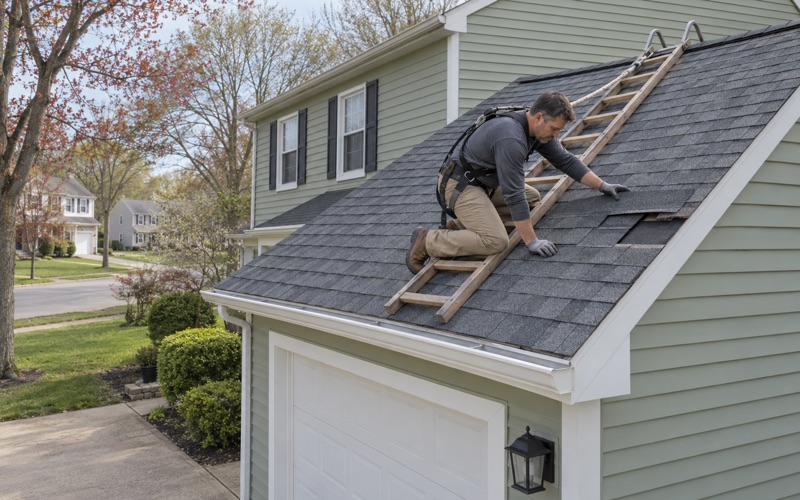
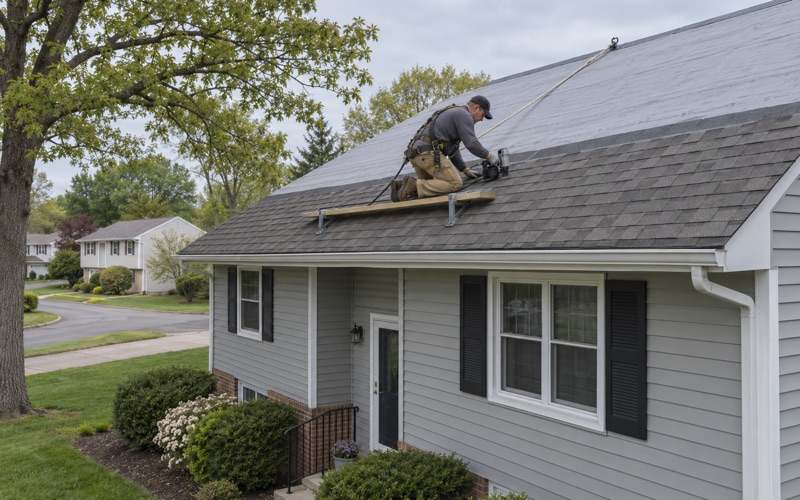
Our post-storm inspection covers the roof surface, the attic and the edges in one visit. On top, we look at shingles along the eaves and valleys, the flashing at chimneys, walls and pipe boots, and the condition of gutters and drip edge. Inside, we check rafters and decking for cracks, sagging or water staining, along with insulation and ventilation at the eaves.
Older roofs bring their own findings. Some homes from these decades carry multiple layers of shingles, original plank sheathing, or chimneys that need a new crown and repointing as well as flashing. We note each of those separately, so you can see what the snow did and what the roof’s age did on its own.
Repair or Replacement
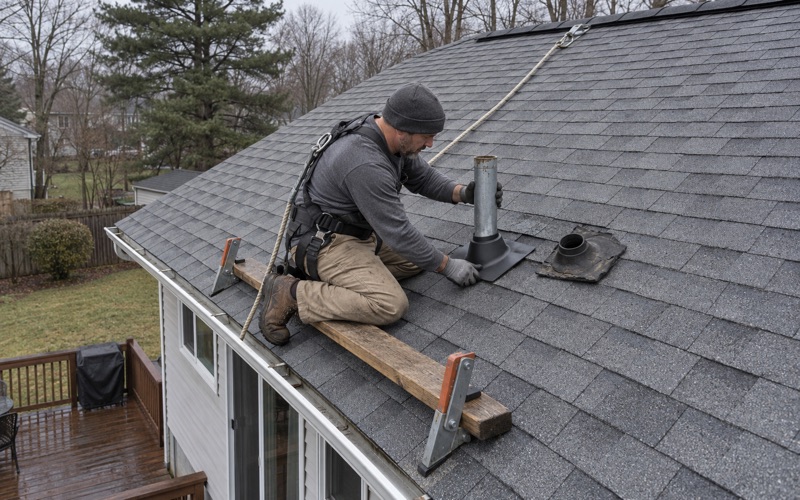
Once the inspection is done, we tell you plainly whether a repair will hold before replacement comes up at all. Many post-storm problems, such as a section of lifted shingles, a failed pipe boot or a run of loose flashing, can be repaired. A roof near the end of its life, or one with widespread decking damage, is a different conversation.
If replacement is the right call, our written scope lists tear-off, decking, underlayment, flashing, ventilation and gutters as separate lines, so you can compare our estimate with another one item by item. Any damaged decking found once the old roof is off is photographed and shown to you before it is replaced, at a per-sheet price already set in the contract.
Contracts follow New Jersey’s home improvement rules, including the three-day cancellation notice, and each quote states sales tax the way the state treats the job: taxable on a repair, exempt on a new roof with Form ST-8. After a winter like the last one, a careful look once the snow has gone is the most useful thing we can offer a Springfield owner.
- 20+ Years on Roofs
- Itemized Written Scopes
- Attic-First Leak Checks