East Brunswick has handled roofing in Warren and across central New Jersey for more than 20 years, and the questions owners bring us have started to change as the township adds attached homes. A townhome roof shares its ridge, its walls and often its paperwork with the units beside it. So the first answer we give is about who decides, not what it costs.
That is why our estimates for attached units open with documents rather than shingles. We read what the community’s governing papers say about roofs, we state in writing whether the job is permit work under the state construction code, and we explain what a shingle warranty actually promises for the kind of building you own.
None of that slows down a leak. Every leak call still starts with a look in the attic as well as on the roof, so the water is traced to where it really gets in. Then we tell you plainly whether a repair will hold before replacement comes up at all.
Fairview at Warren and the Shape of Its Roofs
115 Townhomes in 22 Buildings
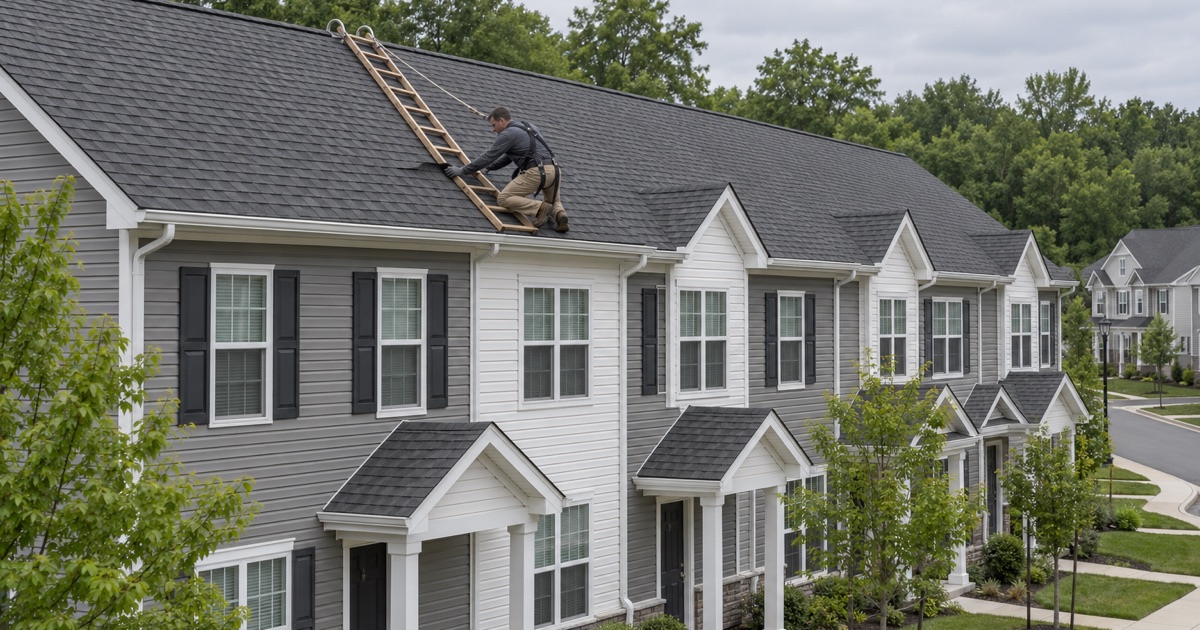
Pulte’s Fairview at Warren sits off Mountain Avenue, immediately off Exit 36 of Interstate 78, with its sales office at 249 Mountain Avenue. The builder’s brochure, dated January 2024, describes 115 townhomes located within 22 buildings, all on two-story plans. Resale listings show units built in 2023 and 2024, which makes these some of the youngest roofs in the township.
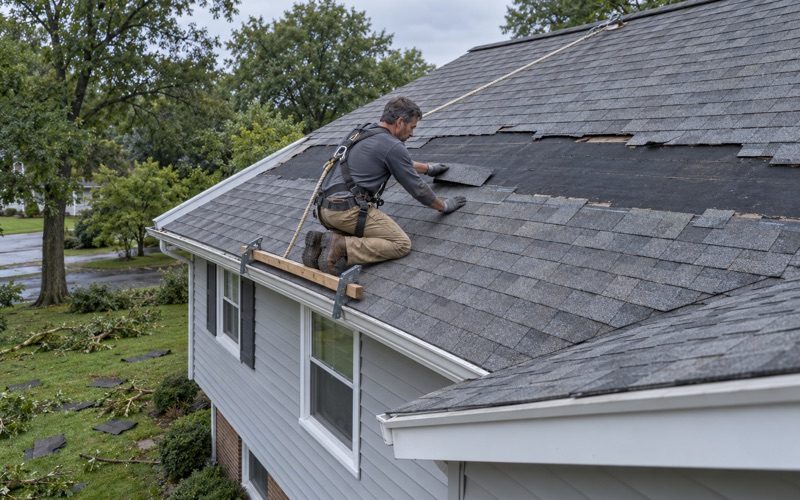
Young roofs rarely need replacing, but they do need the occasional repair after wind lifts a shingle or a pipe boot cracks. On a building that holds several homes under one continuous roofline, even a small repair raises questions a detached house never asks. The first of them is whose roof it actually is.
Attached Homes in a Detached Township
Warren’s housing stock is overwhelmingly detached. The Census Bureau’s 2024 five-year American Community Survey counts 4,857 detached houses among 5,560 housing units, or 87.4 percent. Most roofing work in the township therefore follows the rules written for detached one- and two-family homes.
Fairview, along with the Toll Brothers townhome community known as Villas at Warren, sits outside that pattern. Attached units bring shared walls, shared ridges and an association layer, and the rules that apply to a detached roof do not automatically carry over. Owners moving from a detached house often assume they do, and that assumption is where most surprises begin.
What the Brochure Says About Shingles
The Fairview brochure lists ‘Lifetime Architectural shingles’ among the standard features but does not name a manufacturer. Architectural, or laminated, shingles are a thicker, multi-layer product with a dimensional look. They are a common choice on new construction because they shed wind better than older three-tab styles and hide minor deck irregularities.
Because the brand is not stated, we never assume one. Before any repair on a Fairview unit we look for the product name on closing paperwork, a leftover bundle wrapper in the garage, or a registration record. Matching color and profile on a shared roofline depends on knowing exactly what is already up there.
Looking for roofing closer to Robbinsville? See Robbinsville Roofing.
Permit Work and the Attached Townhouse
Why Detached and Attached Are Treated Differently
New Jersey’s Uniform Construction Code treats replacing the roof covering on a detached one- or two-family dwelling as ordinary maintenance. That provision, in section 5:23-2.7 of the state’s administrative code, is written for detached one- and two-family dwellings only. It does not reach a home that shares a wall and a roof with its neighbors.
A townhouse is an attached unit, so it falls outside that maintenance category. Re-roofing one is construction-permit work handled through the local construction office, with its application and inspection. We plan the schedule around those steps from the start rather than treating the job as a quick swap that can begin the morning after you sign.
What Our Estimate States
Every estimate we write says plainly whether the job is permit work under the state code, and why. We do not repeat the outdated percentage rule some owners still hear about. The current answer turns on the building type and the scope of work, not on how much of the roof is being covered.
Our written scopes also list tear-off, decking, underlayment, flashing, ventilation and gutters as separate lines. On an attached building that matters twice. It lets you compare our number against another contractor’s line by line, and it lets an association or a neighbor see exactly which part of the shared roof the work touches.
Repair Before Replacement
A small fix on a townhome roof, such as resealing a pipe boot or replacing a few wind-lifted shingles, is a different conversation from replacing the covering on a full unit. We tell you which kind of job yours is before you sign. The contract itself follows New Jersey’s home improvement rules, including the three-day cancellation notice.
Repairs also come first in our thinking. If a section of a two-year-old roof can be fixed cleanly, we say so and price only that work. We would rather leave a young roof in service than steer it toward a replacement it does not need.
What ‘Lifetime’ Shingles Mean on a Townhouse
What the Warranty Text Says
Shingle warranties are written around the building and the owner, not just the product. GAF’s published limited warranty, for example, says its Lifetime term applies only to shingles and accessories installed on a single-family detached residence owned by individuals. For other owners and buildings, including condominium or homeowner association ownership and multi-use structures, it gives a 40-year term.
That text does not name townhouses either way. We raise it because the word ‘Lifetime’ in a sales brochure and the term in a manufacturer’s warranty are two different documents. An owner weighing repair against replacement deserves to know which one actually governs the roof over their head.
Why We Don’t Guess the Answer
Fairview’s brochure does not name the shingle maker, and we have not seen any unit’s registration. So we will not tell a Fairview owner what warranty term their roof carries. What we will do is help you find the registration paperwork, read the manufacturer’s actual wording, and note in our estimate how new work might interact with it.
Other major manufacturers publish similar eligibility language, tying their lifetime coverage to single-family detached, owner-occupied homes. On an attached unit, reading that fine print before anyone opens the roof costs far less than discovering a mismatch after the work is done.
Flashing and Ventilation on New Work
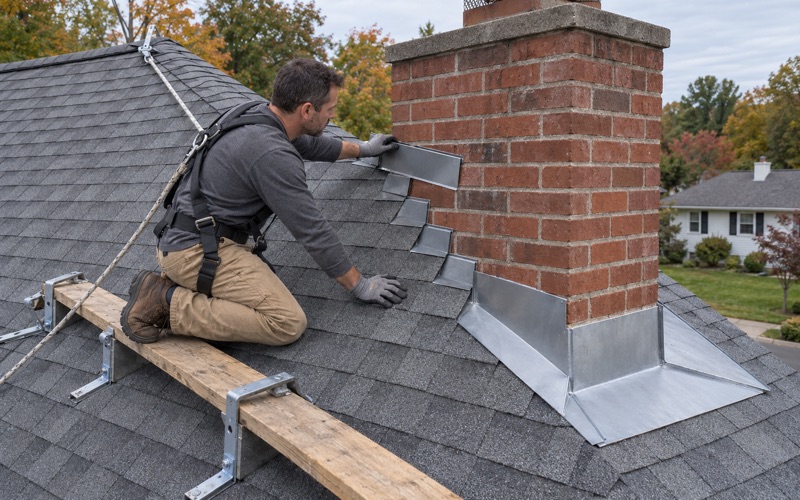
When we do replace roofing on an attached unit, step and counter flashing is replaced with the roof rather than reused under new material. On townhome buildings, the joints where one unit’s roof meets a party wall or a taller neighbor are frequent leak points. That flashing is not the place to save money.
We also check attic ventilation on every replacement. A shared building can split its intake and exhaust between units, and a roof that cannot breathe ages from underneath no matter what any warranty says.
Owner, Association and the Shared Roofline
Reading the Declaration First
Fairview’s homeowners association is managed by Associa, and the brochure lists its fee at $254 a month. Its published duties cover common-area insurance, landscaping, common-area irrigation, snow removal from common roadways and sidewalks, trash pickup, and pump station and basin maintenance. Roofs are not on that list, and homeowners are told they are responsible for their own driveways and service walks.
A brochure list is not the governing document, though. Who owns, insures and replaces each roof is set by the community’s declaration, and we have not read Fairview’s. That is why, in townhouse, condominium and 55+ communities, we check who holds the roof against the association’s documents before we write any estimate.
Repairing One Unit on a Shared Building
A Fairview building holds several townhomes under one roof system, so a repair on one unit can touch shingles, underlayment or flashing that run onto the next. We map exactly where your unit’s work starts and stops and photograph the shared edges before we begin. If the work has to cross that line, the neighboring owner or the association hears about it first.
Matching matters on a building this new, because the same product line can vary slightly between production runs. We source the closest match we can and show it to you before it goes on. If damaged decking turns up once old material is off, we photograph it and show you before replacing it, at a per-sheet price set in the contract.
Storms, Paperwork and a Clean Site
If wind or hail damages a Fairview roof, we photograph and write up the damage for your own claim, and we will meet the insurance adjuster on site when you ask. Whether your policy or the association’s policy responds is a question for your documents and your insurer to settle.
Every work day ends with the driveway, yard and gutters cleaned and a magnet sweep for roofing nails. On a townhome street where the next unit’s car sits a few feet from our ladder, that cleanup is part of the job rather than an extra.
- 20+ Years on Roofs
- Itemized Written Scopes
- Attic-First Leak Checks